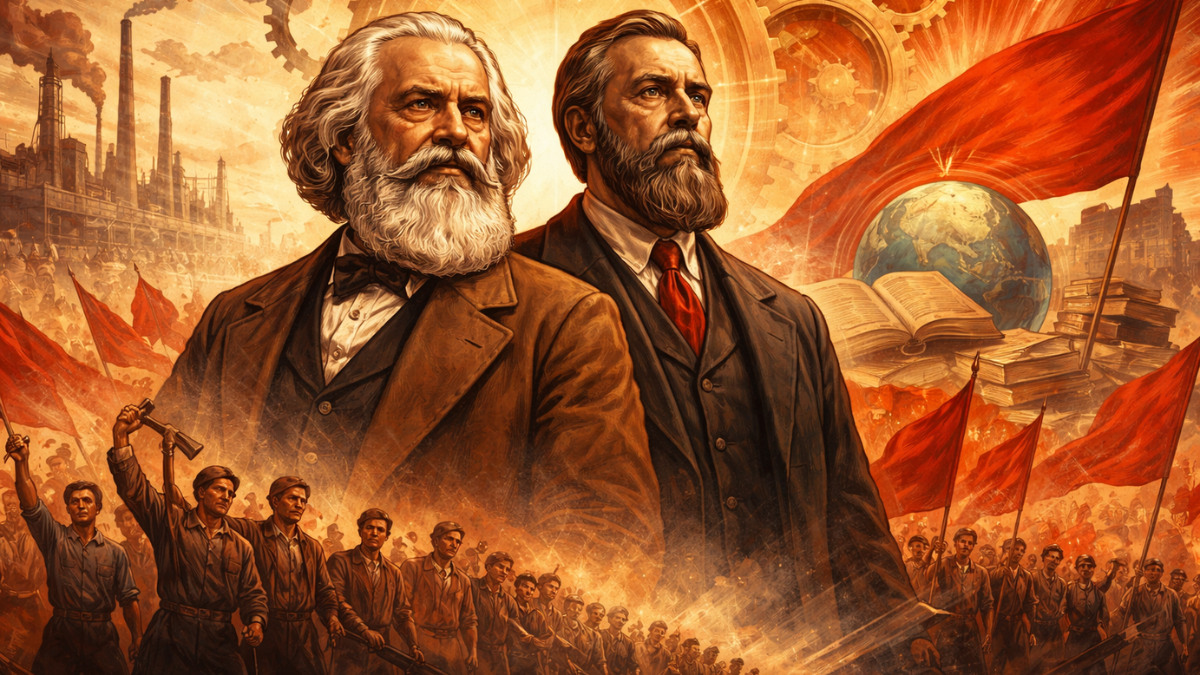
Dialectical and Historical Materialism constitute the philosophical and methodological foundation of Marxist political theory. Developed primarily by Karl Marx and Friedrich Engels in the nineteenth century, these concepts offer a scientific explanation of social change, political transformation, and historical development. They challenge idealist philosophies that prioritize ideas and consciousness as drivers of history, instead emphasizing material conditions, economic structures, and class relations as the core determinants of social evolution.
For Political Science students, understanding Dialectical and Historical Materialism is essential not only for comprehending Marxist theory but also for analyzing power, state formation, class struggle, ideology, and revolutionary change. These concepts continue to influence contemporary debates on capitalism, inequality, globalization, and social movements.

This article explores the philosophical origins, key principles, differences, and political relevance of Dialectical and Historical Materialism in a comprehensive and analytical manner.
Table of Contents
Philosophical Background
Dialectical and Historical Materialism emerged as a synthesis of three intellectual traditions: German philosophy, British political economy, and French socialist thought.
Marx was deeply influenced by G.W.F. Hegel’s dialectical method. Hegel argued that history progresses through contradictions within ideas. According to him, development occurs through a dialectical process often simplified as thesis, antithesis, and synthesis. However, Hegel’s philosophy was idealist; he believed that ideas or “Spirit” drive historical change.
Marx accepted the dialectical method but rejected Hegel’s idealism. He famously declared that he had “turned Hegel on his head.” Instead of ideas shaping material reality, Marx argued that material conditions shape ideas. This inversion formed the basis of Dialectical Materialism.
Additionally, Marx drew from British economists like Adam Smith and David Ricardo, who analyzed labor, value, and capitalism. From French socialists, he inherited concerns about inequality and class conflict. By synthesizing these influences, Marx and Engels developed a materialist interpretation of history grounded in class relations and economic structures.
Dialectical Materialism: The Philosophy of Change
Dialectical Materialism is a philosophical worldview that explains reality as dynamic, interconnected, and driven by contradictions. It combines materialism—the belief that matter is primary—with dialectics—the theory that change occurs through contradictions and conflict.
At its core, Dialectical Materialism rests on three major principles.
First, the unity and struggle of opposites. According to this principle, everything contains internal contradictions. These contradictions generate motion and development. In political terms, the conflict between social classes—such as bourgeoisie and proletariat—drives historical transformation.
Second, the transformation of quantity into quality. Gradual quantitative changes eventually lead to qualitative transformation. For example, small economic crises within capitalism may accumulate until they produce systemic collapse or revolutionary change.

Third, the negation of the negation. Development occurs in stages where one system negates another, yet retains certain elements of the previous stage. Feudalism was negated by capitalism, and capitalism, in Marx’s view, would eventually be negated by socialism.
Dialectical Materialism rejects static explanations of politics and society. Instead, it emphasizes motion, conflict, and transformation. For Political Science students, this perspective is useful in analyzing political revolutions, regime changes, and ideological struggles.
Materialism: The Primacy of Matter
Materialism, in Marxist philosophy, asserts that material conditions—economic production, labor, technology, and property relations—are the foundation of society. Consciousness does not determine life; rather, social life determines consciousness.
This argument challenges religious, moral, and idealist explanations of politics. For example, instead of viewing democracy as merely a product of noble ideals, a materialist analysis would examine the economic forces, class structures, and production systems that enable or limit democratic institutions.
In this sense, the state, law, and political institutions are not neutral entities. They reflect the interests of dominant economic classes. Thus, materialism provides a structural approach to political analysis.
Historical Materialism: The Science of Social Development
While Dialectical Materialism is the philosophical method, Historical Materialism is its application to human history. It explains how societies evolve through changes in their modes of production.
Historical Materialism proposes that history progresses through distinct stages characterized by specific economic systems. These stages include primitive communism, slavery, feudalism, capitalism, socialism, and eventually communism.
Each stage is defined by the relationship between productive forces (tools, technology, labor power) and relations of production (property relations, class structures). When productive forces develop beyond the limits of existing relations of production, contradictions emerge. These contradictions produce class struggle and social revolution.
For example, under feudalism, land was the primary means of production, and society was divided between feudal lords and serfs. With the rise of industrial technology, feudal relations became restrictive. The bourgeois revolutions in Europe transformed feudal societies into capitalist states.
Thus, Historical Materialism views history not as a series of random events or actions of great individuals but as a structured process driven by economic contradictions and class conflict.
Base and Superstructure
One of the most important concepts in Historical Materialism is the distinction between the economic base and the superstructure.
The economic base consists of the forces and relations of production. The superstructure includes political institutions, legal systems, culture, religion, and ideology.
According to Marx, the base determines the superstructure. Political institutions are shaped by economic relations. For instance, capitalist economies tend to produce legal systems that protect private property and individual contracts.
However, the relationship is not mechanical. The superstructure can influence the base as well, especially through ideology and state power. Nevertheless, the economic structure remains the foundation of social organization.
For Political Science students, this framework helps explain why political systems vary across different economic contexts.
Class Struggle as the Motor of History
Historical Materialism emphasizes class struggle as the driving force of social change. In every historical stage, society is divided into classes with opposing interests.
Under capitalism, the central conflict is between the bourgeoisie, who own the means of production, and the proletariat, who sell their labor power. The bourgeoisie seek profit maximization, while the proletariat seek better wages and working conditions.

This conflict is not merely economic but political. The state, in Marx’s view, functions as an instrument of class domination. Laws, policies, and institutions reflect the interests of the ruling class.
Revolution occurs when class contradictions become irreconcilable. The working class develops class consciousness, recognizes its exploitation, and organizes to overthrow the capitalist system.
This theory provides a structural explanation of political revolutions and social movements.
Critiques of Dialectical and Historical Materialism
Despite its influence, Marxist theory has faced several criticisms.
First, critics argue that it is economically deterministic. By emphasizing economic factors, it allegedly underestimates the role of culture, religion, and individual agency.
Second, some scholars contend that predicted capitalist collapse has not occurred in the manner Marx envisioned. Capitalist systems have shown adaptability through welfare policies, labor rights, and technological innovation.
Third, liberal theorists argue that the state is not always a tool of class domination but can represent diverse interests in pluralistic societies.
However, defenders argue that Marxism provides a powerful analytical tool for understanding inequality, globalization, imperialism, and economic crises.
Contemporary Relevance
Dialectical and Historical Materialism remain relevant in analyzing modern political issues.
Global capitalism continues to produce economic inequality and labor exploitation. The 2008 financial crisis demonstrated systemic contradictions within financial capitalism. Growing wealth concentration raises questions about class power and state policies.
Moreover, debates on globalization, neoliberalism, and corporate power reflect Marxist concerns about economic structures shaping political outcomes.
Even scholars who reject orthodox Marxism often use materialist approaches to analyze political economy, development, and international relations.
In the Global South, including countries in Asia, Africa, and Latin America, Marxist theory has influenced liberation movements and anti-colonial struggles. It provides a framework to examine dependency, imperialism, and unequal exchange.
Differences Between Dialectical and Historical Materialism
Though interconnected, the two concepts are distinct.
Dialectical Materialism is the general philosophical method explaining change in nature and society through contradictions.
Historical Materialism specifically applies this method to the study of human history and social formations.
In simple terms, Dialectical Materialism answers how change occurs, while Historical Materialism explains why social change occurs in particular historical contexts.
Significance for Political Science Students
For Political Science students, Dialectical and Historical Materialism offer several analytical advantages:
- They provide a structural understanding of power and state formation.
- They explain revolutions as outcomes of material contradictions.
- They link economic systems to political institutions.
- They emphasize inequality and class dynamics in governance.
Rather than studying political events in isolation, students learn to connect policies, institutions, and ideologies to underlying economic structures.
This approach deepens critical thinking and encourages examination of hidden power relations within society.
Conclusion
Dialectical and Historical Materialism form the intellectual backbone of Marxist political theory. By emphasizing material conditions, contradictions, and class struggle, they provide a comprehensive explanation of social and political transformation.
Dialectical Materialism explains the dynamic nature of reality, highlighting conflict as the engine of development. Historical Materialism applies this method to human society, demonstrating how economic structures shape historical progression.
Despite criticisms, these concepts remain foundational in Political Science. They continue to inspire debates on capitalism, inequality, state power, and global political economy.
For students seeking to understand the structural roots of political change, Dialectical and Historical Materialism offer not merely a theory of the past but a framework for analyzing the present and imagining alternative futures.
FAQs on Dialectical and Historical Materialism
1. What is Dialectical Materialism?
Dialectical Materialism is a philosophical approach developed by Karl Marx and Friedrich Engels that explains change in nature and society through contradictions in material conditions rather than ideas.
2. What is Historical Materialism?
Historical Materialism is the application of dialectical principles to human history. It argues that economic structures and class relations determine the development of societies.
3. Who developed Dialectical and Historical Materialism?
Karl Marx and Friedrich Engels developed these concepts in the 19th century as the foundation of Marxist political theory.
4. How does Dialectical Materialism differ from Hegel’s dialectics?
Hegel believed ideas drive history (idealism), while Marx argued that material conditions drive ideas (materialism).
5. What are the main principles of Dialectical Materialism?
The main principles include:
- Unity and struggle of opposites
- Transformation of quantity into quality
- Negation of the negation
6. What does Historical Materialism say about social change?
It states that social change occurs when contradictions between productive forces and relations of production lead to class struggle and revolution.
7. What is meant by ‘mode of production’?
The mode of production refers to the combination of productive forces (labor, tools, technology) and relations of production (property ownership and class relations).
8. What is the concept of base and superstructure?
The economic base (mode of production) shapes the superstructure, which includes political institutions, law, religion, and ideology.
9. Why is class struggle important in Historical Materialism?
Class struggle is considered the driving force of history because opposing class interests create conflict that leads to social transformation.
10. How does Historical Materialism explain capitalism?
It explains capitalism as a stage in history characterized by private ownership of the means of production and exploitation of labor by the bourgeoisie.
11. What is the role of the state in Marxist theory?
According to Marxism, the state functions as an instrument of the ruling class to maintain its dominance over other classes.
12. Is Dialectical Materialism economically deterministic?
Critics argue it is economically deterministic, but supporters claim it recognizes interaction between economic base and superstructure.
13. What are the historical stages identified in Historical Materialism?
Primitive communism, slavery, feudalism, capitalism, socialism, and communism.
14. Why are Dialectical and Historical Materialism important in Political Science?
They help students analyze power, inequality, state formation, revolutions, and the relationship between economy and politics.
15. Are Dialectical and Historical Materialism still relevant today?
Yes, they remain relevant for understanding global capitalism, economic crises, class inequality, and political conflicts in modern society.
1 thought on “Dialectical and Historical Materialism: A Foundational Framework in Political Theory”