Introduction
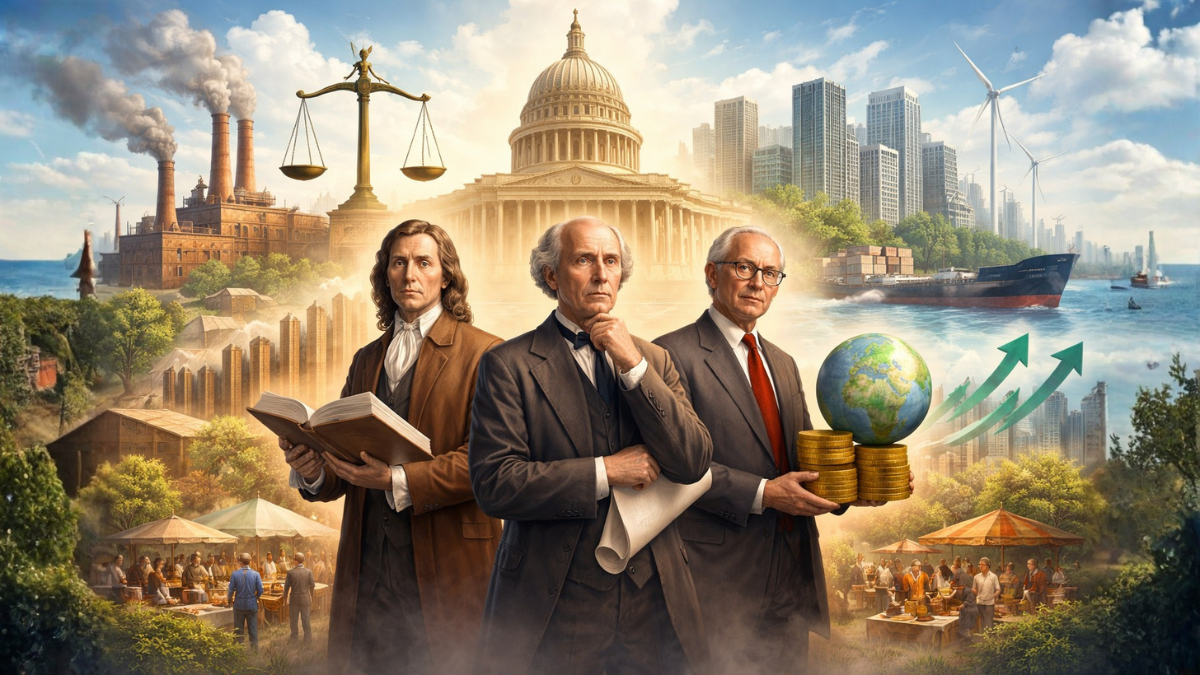
Liberalism is one of the most influential political ideologies in modern political thought. Emerging in Europe during the seventeenth and eighteenth centuries, it developed as a response to absolute monarchy, feudal privilege, religious domination, and arbitrary political authority. Liberalism champions individual liberty, rule of law, constitutional government, and rational progress. However, liberalism is not a single, fixed doctrine. Over time, it has evolved into different strands reflecting changing social, economic, and political realities.
Broadly, liberalism can be divided into three major phases: Classical (Negative) Liberalism, Positive Liberalism, and Neo-Classical Liberalism (often called Neo-liberalism in modern discourse). Each phase offers a distinct understanding of freedom, the role of the state, and the relationship between individual and society.
This article examines these three strands systematically, highlighting their philosophical foundations, major thinkers, core principles, and criticisms.

Table of Contents
I. Classical Liberalism (Negative Liberalism)
Historical Background
Classical liberalism emerged in the seventeenth and eighteenth centuries in Western Europe, particularly in England and France. It arose in opposition to absolute monarchy and mercantilist economic control. The Glorious Revolution (1688), the American Revolution (1776), and the French Revolution (1789) reflected classical liberal ideas.
Key thinkers include John Locke, Adam Smith, Jeremy Bentham, and John Stuart Mill (in his early writings).
Concept of Negative Liberty
Classical liberalism is often described as “negative liberalism” because it defines liberty as freedom from interference. According to this view, an individual is free when the state or other individuals do not interfere with their actions.
John Locke argued that individuals possess natural rights—life, liberty, and property. The state is created through a social contract to protect these rights. If the state violates them, people have the right to revolt.
Negative liberty emphasizes:
- Limited government
- Protection of private property
- Free market economy
- Individual autonomy
- Rule of law
The state should function as a “night-watchman state”, restricting itself to maintaining law and order, national defense, and protection of property.
Economic Philosophy
Classical liberalism strongly supports laissez-faire capitalism. Adam Smith, in The Wealth of Nations, argued that economic prosperity is best achieved when individuals pursue their self-interest in a free market guided by the “invisible hand.”
The role of government in the economy should be minimal. State intervention distorts competition and reduces efficiency.
Political Principles
Classical liberals advocate:
- Constitutional government
- Separation of powers
- Representative democracy (though initially limited to property owners)
- Civil liberties such as freedom of speech and religion
Criticisms of Classical Liberalism
- It ignores social and economic inequalities.
- Absolute freedom may lead to exploitation of weaker sections.
- It assumes that all individuals are equally capable of using freedom.
- Industrial capitalism created poverty and harsh working conditions, exposing the limits of laissez-faire ideology.
These criticisms led to the evolution of positive liberalism.
II. Positive Liberalism (Modern Liberalism)
Historical Context
By the late nineteenth century, industrialization had created massive social inequalities, unemployment, slums, and labor exploitation. The purely negative conception of liberty was insufficient to address these issues.
New liberal thinkers such as T. H. Green, L. T. Hobhouse, and later economists like John Maynard Keynes reshaped liberalism.
Concept of Positive Liberty
Positive liberalism defines liberty as the ability to develop one’s potential. Freedom is not merely absence of restraint; it is the presence of conditions that enable individuals to flourish.

T. H. Green argued that real freedom requires access to education, health, and economic security. Poverty and ignorance are barriers to freedom. Therefore, the state must actively remove these obstacles.
Role of the State
Unlike classical liberals, positive liberals support an active welfare state. The state must:
- Provide public education
- Regulate working conditions
- Ensure minimum wages
- Offer social security
- Reduce economic inequalities
The state is not seen as an enemy of liberty but as an instrument for promoting social justice.
Economic Policy
Positive liberalism supports regulated capitalism. Keynes argued that during economic crises, government intervention is necessary to stimulate demand and prevent unemployment.
This thinking influenced welfare state policies in Europe and America after World War II.
Political Philosophy
Positive liberalism broadens democracy by supporting:
- Universal adult franchise
- Labor rights
- Social legislation
- Welfare programs
It recognizes that political equality is meaningless without economic equality.
Criticisms of Positive Liberalism
- Expanding state power may threaten individual liberty.
- Welfare policies can create dependency.
- High taxation may discourage entrepreneurship.
- Bureaucratic inefficiency can undermine policy goals.
These concerns contributed to the rise of neo-classical liberalism in the late twentieth century.
III. Neo-Classical Liberalism (Neo-Liberalism)
Historical Emergence
Neo-classical liberalism developed in the mid-twentieth century as a reaction against excessive state intervention and welfare expansion. Economic stagnation and inflation in the 1970s encouraged a revival of free-market ideas.
Prominent thinkers include Friedrich Hayek, Milton Friedman, and Robert Nozick.
Core Principles
Neo-classical liberalism seeks to restore classical liberal values but in a modern context.
It emphasizes:
- Market efficiency
- Privatization
- Deregulation
- Reduction of welfare spending
- Globalization
Friedrich Hayek argued that centralized planning leads to tyranny because no authority can possess complete knowledge of market conditions. Markets are spontaneous orders that coordinate individual actions efficiently.
Milton Friedman supported monetarism and argued for controlling inflation by regulating money supply rather than increasing government spending.
Robert Nozick defended the minimal state in Anarchy, State, and Utopia, arguing that redistributive taxation violates individual rights.
Political Impact
Neo-classical liberalism influenced policies in the 1980s under leaders like Margaret Thatcher in the United Kingdom and Ronald Reagan in the United States.
Policies included:
- Privatization of public enterprises
- Tax cuts
- Reduction of trade barriers
- Deregulation of industries
Global Dimension
Neo-liberalism became central to global institutions such as the International Monetary Fund and the World Bank, which promoted structural adjustment programs in developing countries.
Criticisms of Neo-Classical Liberalism
- It increases economic inequality.
- Privatization may neglect public welfare.
- Market fundamentalism can weaken social solidarity.
- Globalization may undermine national sovereignty.
Critics argue that neo-liberal policies have widened the gap between rich and poor both within and between countries.
Comparative Analysis
| Feature | Classical Liberalism | Positive Liberalism | Neo-Classical Liberalism |
|---|---|---|---|
| Concept of Liberty | Negative (freedom from interference) | Positive (freedom to develop) | Market-centered freedom |
| Role of State | Minimal | Welfare-oriented | Minimal but market-focused |
| Economic Policy | Laissez-faire | Regulated capitalism | Deregulated capitalism |
| View of Equality | Legal equality | Social and economic equality | Equality of opportunity |
Classical liberalism prioritizes individual autonomy, positive liberalism emphasizes social justice, and neo-classical liberalism reasserts market supremacy in a globalized world.
Relevance in Contemporary Politics
Liberalism remains central to modern democracies. Human rights discourse, constitutionalism, and civil liberties derive from classical liberal foundations. Welfare states reflect positive liberal principles. Global capitalism and privatization policies reveal neo-classical influence.
In developing countries, debates continue regarding the balance between market freedom and social justice. Political science students must understand that liberalism is dynamic and adaptive, not static.
Conclusion
Liberalism has undergone significant transformation from its classical origins to its modern and neo-classical forms. Classical liberalism emphasized negative liberty and minimal state intervention. Positive liberalism expanded the concept of freedom to include social welfare and state responsibility. Neo-classical liberalism revived market-oriented principles while responding to welfare state excesses.
Despite internal differences, all forms of liberalism share a commitment to individual dignity, rationality, and constitutional governance. The tension between liberty and equality remains central to liberal thought. Understanding these variations enables students to analyze contemporary political debates more effectively.
Liberalism’s evolution demonstrates that political ideologies adapt to historical circumstances. As societies change, liberalism continues to redefine freedom, state power, and economic organization. Its enduring influence ensures that it remains a foundational subject in political science studies.
FAQs
1. What is Liberalism in Political Science?
Liberalism is a political ideology that emphasizes individual liberty, constitutional government, rule of law, and protection of rights against arbitrary authority.
2. What is Classical (Negative) Liberalism?
Classical liberalism defines freedom as the absence of interference. It supports limited government, private property, and free markets.
3. Who is considered the father of Classical Liberalism?
John Locke is widely regarded as the father of classical liberalism due to his theory of natural rights and limited government.
4. What is Negative Liberty?
Negative liberty means freedom from external interference, especially by the state.
5. What is Positive Liberalism?
Positive liberalism argues that true freedom requires social and economic conditions such as education, health, and economic security.
6. Who introduced the concept of Positive Liberty?
T. H. Green played a key role in developing the concept of positive liberty in modern liberal thought.
7. How does Positive Liberalism view the State?
Positive liberalism sees the state as an instrument to promote social welfare and remove obstacles to individual development.
8. What is Neo-Classical Liberalism?
Neo-classical liberalism (often called neo-liberalism) revives free-market principles and argues for reduced state intervention in economic affairs.
9. Who are major thinkers of Neo-Classical Liberalism?
Important thinkers include Friedrich Hayek and Milton Friedman.
10. What is the difference between Negative and Positive Liberty?
Negative liberty focuses on freedom from interference, while positive liberty focuses on the capacity to achieve one’s potential.
11. Why did Positive Liberalism emerge?
It emerged in response to industrialization, economic inequality, and social problems created by unregulated capitalism.
12. What is the economic policy of Classical Liberalism?
It supports laissez-faire capitalism, free trade, and minimal state regulation.
13. How does Neo-Classical Liberalism differ from Classical Liberalism?
Neo-classical liberalism adapts classical ideas to modern global capitalism, emphasizing privatization and deregulation in a globalized economy.
14. What are the criticisms of Neo-Classical Liberalism?
Critics argue that it increases inequality, reduces welfare protections, and prioritizes markets over social justice.
15. Why is Liberalism important for Political Science students?
Liberalism forms the foundation of modern democracy, human rights, constitutionalism, and global economic systems, making it essential for understanding contemporary politics.