
Introduction
Among the greatest political philosophers in human history, Plato occupies a unique place. His ideas have shaped political thought for more than two thousand years and continue to influence debates about justice, governance, education, and morality. Living during a period of political instability in ancient Greece, Plato sought to understand why states fail and how societies can achieve harmony and stability. His most famous work, the book Republic, presents a detailed discussion of justice and the structure of an ideal state.
Plato believed that political problems arise from moral failures. According to him, a good state can only exist when citizens and rulers possess virtue and wisdom. Therefore, his theory of justice is not merely a legal concept but a moral principle that guides individuals and society. The ideal state envisioned by Plato aims to create social harmony through specialization, education, and wise leadership.
This article examines Plato’s concept of justice, the organization of the ideal state, the role of education, the philosopher-king, and the major criticisms of his political philosophy.

Table of Contents
Historical Background of Plato’s Political Thought
Plato was born around 427 BCE in Athens during the turbulent years of the Peloponnesian War. The political instability of Athens greatly influenced his thinking. He witnessed the decline of Athenian democracy and the execution of his teacher, Socrates, by the democratic government.
The death of Socrates deeply affected Plato. He became critical of democratic politics, believing that uninformed citizens often made irrational decisions. This experience encouraged him to search for a political system based on knowledge, virtue, and justice rather than popular opinion.
His political ideas were largely developed in Republic, Statesman, and Laws. Among these works, Republic remains the most influential and contains his fullest account of justice and the ideal state.
Plato’s Understanding of Justice

Justice is the central theme of Plato’s political philosophy. In Republic, Plato begins by asking a simple but profound question: What is justice?
Unlike modern thinkers who often define justice in terms of rights, equality, or law, Plato understood justice as harmony. He believed that justice exists when every part of a system performs its proper function without interfering with others.
According to Plato, justice operates at two levels:
Justice in the Individual
Plato viewed the human soul as consisting of three parts:
- Reason
- Spirit
- Appetite
Reason seeks truth and wisdom. Spirit represents courage, honor, and ambition. Appetite includes physical desires such as hunger, wealth, and pleasure.
A just person is one in whom reason governs spirit and appetite. When each part performs its proper role under the guidance of reason, inner harmony is achieved. Justice, therefore, is a condition of moral balance within the individual.
Justice in Society
Plato believed that the state reflects the structure of the human soul. Just as the soul has three parts, society contains three classes:
- Rulers
- Guardians or Soldiers
- Producers
Justice exists when each class performs its assigned duties without interfering in the functions of other classes. Social harmony emerges when rulers govern wisely, soldiers protect the state courageously, and producers engage in economic activities efficiently.
Thus, justice means “each person doing the work for which he or she is naturally suited.”
The Theory of the Ideal State
Plato’s ideal state is based on the principle of specialization. He argued that individuals possess different natural abilities and talents. Society functions best when people perform tasks according to their abilities.
The ideal state is organized into three classes corresponding to the three parts of the soul.
The Ruling Class
The ruling class consists of philosopher-kings. These individuals possess wisdom, intelligence, and moral virtue. They are responsible for making laws and governing society.
Plato believed that political power should be entrusted to those who understand truth and justice rather than those who seek wealth or popularity. Since philosophers pursue knowledge and wisdom, they are best suited to govern.
The Guardian Class
The guardians serve as soldiers and defenders of the state. Their primary duty is to protect society from internal disorder and external threats.
Guardians must possess courage, discipline, and loyalty. They act as the enforcement arm of the state while remaining subordinate to the philosopher-rulers.
The Producer Class
The largest group in society consists of producers, including farmers, artisans, merchants, and workers.
These individuals provide economic goods and services necessary for social survival. While they do not participate directly in governance, their contribution is essential for maintaining social stability.
The Philosopher-King
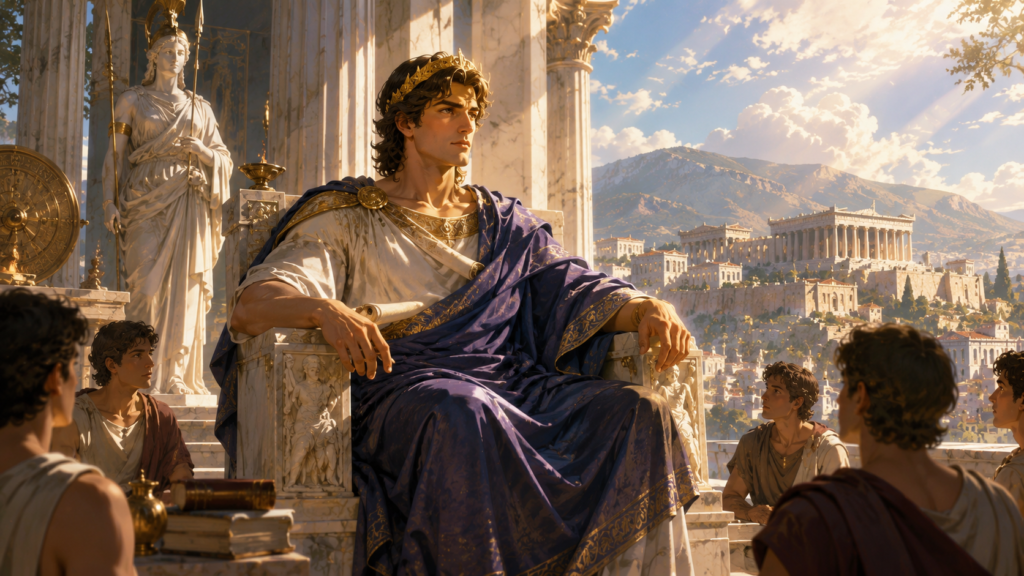
One of Plato’s most famous ideas is the concept of the philosopher-king.
Plato argued that political problems arise because rulers often lack wisdom while wise individuals avoid politics. To solve this problem, he proposed that philosophers should become rulers or rulers should become philosophers.
The philosopher-king possesses several qualities:
- Love of truth
- Intellectual excellence
- Moral integrity
- Self-discipline
- Commitment to public welfare
According to Plato, philosophers understand the eternal Forms, especially the Form of the Good. This knowledge enables them to make decisions that promote justice and social harmony.
The philosopher-king governs not for personal gain but for the welfare of society as a whole.
The Theory of Forms and Political Philosophy
Plato’s political ideas cannot be fully understood without considering his Theory of Forms.
He believed that the physical world is imperfect and constantly changing. Beyond the material world exists a higher realm of perfect and eternal Forms.
For example, there are many imperfect examples of justice in society, but there exists an ideal Form of Justice that represents perfect justice.
Philosophers, through education and rational inquiry, can understand these eternal truths. Their knowledge allows them to govern wisely and establish a just political order.
The Theory of Forms therefore provides the philosophical foundation for Plato’s ideal state.
Education in the Ideal State
Education occupies a central place in Plato’s political theory.
He believed that good governance depends on proper education. The state should supervise education to ensure that citizens develop virtue and wisdom.
The educational system is highly structured and selective. Children are tested at various stages to determine their abilities and social roles.
Early education focuses on:
- Physical training
- Moral development
- Music and literature
- Intellectual discipline
Only the most talented students continue to advanced studies in mathematics, philosophy, and dialectics. Those who successfully complete this rigorous process become philosopher-rulers.
For Plato, education is not merely the acquisition of knowledge; it is the cultivation of character and virtue.
Communism of the Guardians
Plato proposed a unique form of communism for the guardian class.
Guardians and rulers would not own private property. They would live collectively and share resources.
Plato believed that private wealth creates selfish interests and corruption. By eliminating personal property among rulers, he hoped to ensure that they govern solely for the public good.
Similarly, he proposed communal family arrangements for guardians to prevent favoritism and promote loyalty to the state.
This aspect of Plato’s philosophy has generated significant controversy and criticism throughout history.
The Role of Women in the Ideal State
Compared to many ancient thinkers, Plato adopted relatively progressive views regarding women.
He argued that women possess the same fundamental capacities as men, although they may differ physically. Therefore, women should have access to education and public service if they demonstrate the necessary abilities.
In the guardian class, women could receive military and philosophical training and participate in governing the state.
This position was remarkable in the context of ancient Greek society, where women generally had limited public roles.
Plato’s Critique of Democracy
Plato was highly critical of democracy.
He believed democratic systems often encourage leaders to seek popularity rather than truth. Citizens may be influenced by emotions, rhetoric, and personal interests rather than reason.
According to Plato, excessive freedom can lead to disorder, instability, and eventually tyranny. When democratic governments fail to maintain discipline, ambitious individuals may seize power and establish authoritarian rule.
His skepticism toward democracy reflected his observations of Athenian politics and the execution of Socrates.
Although controversial, Plato’s critique continues to inspire discussions about the strengths and weaknesses of democratic governance.
The Decline of Political Systems
In Republic, Plato describes a cycle of political decline.
The ideal state gradually deteriorates through several stages:
- Aristocracy – Rule by the wise and virtuous.
- Timocracy – Rule by the honor-loving military class.
- Oligarchy – Rule by the wealthy.
- Democracy – Rule by the masses.
- Tyranny – Rule by a dictator.
Plato believed that each stage contains internal weaknesses that eventually lead to further decline. Tyranny represents the worst form of government because it is based on fear, oppression, and personal ambition.
Criticisms of Plato’s Ideal State
Despite its influence, Plato’s political philosophy has faced substantial criticism.
One criticism concerns its authoritarian nature. Critics argue that concentrating power in the hands of philosopher-kings may lead to dictatorship rather than justice.
Another criticism involves the rigid class structure. Plato assumes that individuals should remain within predetermined social roles, limiting personal freedom and social mobility.
Many scholars also reject his opposition to democracy, arguing that democratic institutions provide accountability and protect individual rights.
His proposal for communal property and family arrangements among guardians is often considered unrealistic and impractical.
Furthermore, critics question whether philosophers necessarily possess the practical skills required for effective political leadership.
Contemporary Relevance of Plato’s Theory
Although written more than two millennia ago, Plato’s ideas remain relevant today.
Modern discussions about ethical leadership, political corruption, educational reform, and social justice continue to reflect Platonic concerns.
His emphasis on merit-based leadership raises important questions about the qualifications of political leaders. His critique of uninformed public opinion remains relevant in an era of social media, misinformation, and political polarization.
Similarly, his belief that education is essential for responsible citizenship continues to influence contemporary educational philosophy.
While few would support Plato’s ideal state in its entirety, many of his insights remain valuable for understanding political life.
Conclusion
Plato’s theory of justice and the ideal state represents one of the most significant contributions to political philosophy. He defined justice as harmony, both within the individual and within society. Through specialization, education, and wise leadership, Plato sought to create a political order based on virtue and reason.
His ideal state is structured around three classes—rulers, guardians, and producers—each performing its proper function. At the center of this system stands the philosopher-king, whose wisdom enables just governance.
Although critics have challenged the practicality and democratic legitimacy of Plato’s proposals, his ideas continue to shape political thought across the world. His exploration of justice, leadership, education, and morality remains a foundational part of political science.
Ultimately, Plato’s vision reminds us that political institutions cannot be separated from ethical values. A just society depends not only on laws and structures but also on the character, wisdom, and virtue of its citizens and leaders.
FAQs
1. What is the ideal state according to Plato?
The ideal state according to Plato is a perfectly organized society where justice prevails because each social class performs its proper function under the guidance of wise philosopher-kings.
2. Why did Plato propose the concept of the ideal state?
Plato proposed the ideal state to create a society based on justice, harmony, wisdom, and moral virtue, free from corruption and political instability.
3. What are the main classes in Plato’s ideal state?
Plato’s ideal state consists of three classes: the rulers (philosopher-kings), the guardians (soldiers), and the producers (farmers, artisans, and merchants).
4. Who governs the ideal state?
In the ideal state, philosopher-kings govern because they possess knowledge, wisdom, and a deep understanding of justice and the common good.
5. How is justice maintained in the ideal state?
Justice in the ideal state is maintained when every individual and social class performs its assigned role without interfering in the duties of others.
6. What role does education play in the ideal state?
Education is essential in the ideal state because it develops virtue, identifies talented individuals, and prepares future rulers and guardians.
7. Did Plato allow private property in the ideal state?
In Plato’s ideal state, the ruling and guardian classes are not allowed to own private property, while the producer class may possess personal wealth and property.
8. What is the relationship between the ideal state and the philosopher-king?
The philosopher-king is the central figure of the ideal state, providing wise leadership and ensuring that governance is based on reason rather than personal interests.
9. Why is Plato’s ideal state criticized?
Critics argue that Plato’s ideal state is overly authoritarian, limits individual freedom, and relies too heavily on the wisdom of a small ruling elite.
10. What is the contemporary relevance of the ideal state?
The concept of the ideal state remains relevant because it encourages discussions about ethical leadership, social justice, political responsibility, and the role of education in governance.