Introduction
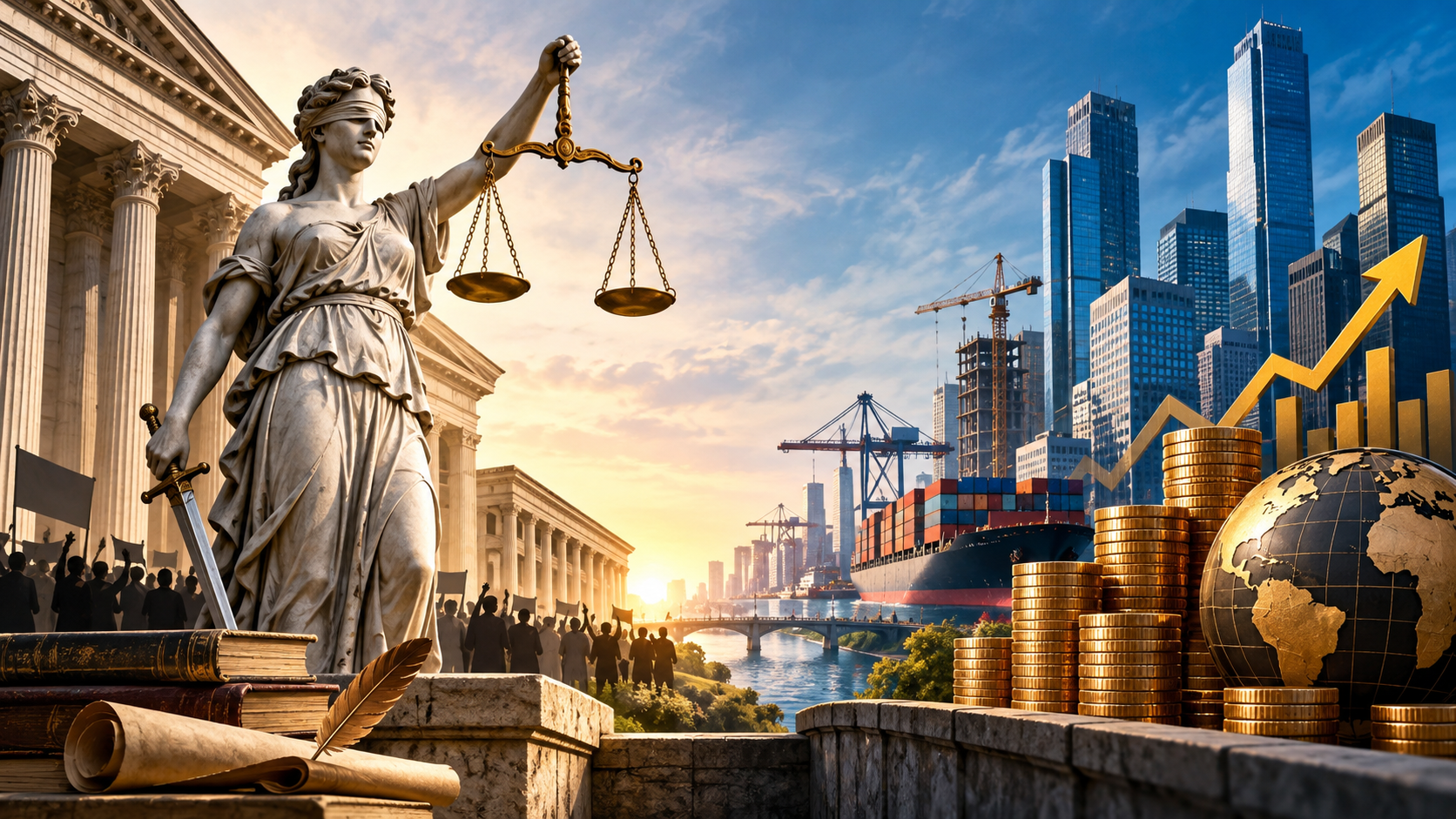
Liberalism and capitalism are two of the most influential ideas in modern political and economic thought. Although they are often discussed together, they are not identical concepts. Liberalism is primarily a political and philosophical tradition concerned with individual liberty, rights, equality before the law, constitutional government, and limitations on political power. Capitalism, by contrast, is an economic system organized largely around private property, markets, voluntary exchange, investment, and the pursuit of profit.
Historically, however, the development of liberalism and capitalism has been closely connected. The rise of commercial society, private property, industrialization, and the modern middle class created conditions in which liberal ideas could develop and expand. Classical liberal thinkers argued that individual freedom required protection from excessive state intervention, while economic freedom was considered an important dimension of individual liberty. The Stanford Encyclopedia of Philosophy notes that classical liberalism historically connected private property and market institutions closely with individual freedom.
Yet the relationship between liberalism and capitalism has always been contested. Critics argue that unrestricted capitalism can generate economic inequality and unequal political power, potentially weakening the substantive meaning of political equality. Supporters respond that private property, markets, competition, and economic freedom can limit concentrated state power and expand individual choice.
Therefore, the relationship between liberalism and capitalism should not be understood simply as a natural partnership. It is better understood as an ongoing political debate about freedom, property, equality, democracy, state power, and social justice.
Table of Contents
Meaning and Core Principles of Liberalism
Liberalism emerged as a major political tradition during the transformation of European society between the seventeenth and nineteenth centuries. The decline of absolute monarchy, the development of constitutional government, religious conflicts, the Enlightenment, and the expansion of commercial society contributed to the intellectual environment in which liberal political thought developed.
At its centre is the principle of individual liberty. Liberal political theory generally begins with the idea that individuals possess certain freedoms that political authorities must respect and justify before restricting. John Locke emphasized natural rights and government based on consent, while later thinkers such as John Stuart Mill developed arguments concerning individual freedom and limitations on state interference.
Modern liberalism is not a single doctrine. It contains classical, social, welfare, egalitarian, libertarian, and other interpretations. The Stanford Encyclopedia of Philosophy emphasizes that liberalism contains competing understandings of liberty and disagreements about the relationship between individual freedom, private property, markets, and government intervention.
Classical liberalism generally gives considerable importance to private property, contractual freedom, free exchange, and limited government. Social or modern liberalism, however, argues that formal freedom may be insufficient when individuals lack education, healthcare, economic security, or meaningful opportunities. Consequently, it gives the state a greater role in creating conditions under which citizens can exercise freedom effectively.
Thus, liberalism should not automatically be equated with laissez-faire economics. A central debate within liberalism itself concerns how much economic intervention is compatible with liberty.
Understanding Capitalism
Capitalism is an economic system in which productive assets can be privately owned and economic activity is substantially coordinated through markets. Individuals and firms generally make decisions about production, investment, employment, and consumption, while prices are influenced by supply and demand.
Capitalism is associated with several important institutions: private property, markets, wage labour, entrepreneurship, capital accumulation, competition, investment, and profit. However, actual capitalist economies differ considerably. Most contemporary capitalist societies combine markets with taxation, regulation, public services, social insurance, labour laws, and government intervention.
The political theory of capitalism therefore cannot be reduced to the statement that capitalism means “no government.” Different capitalist systems have different relationships between markets and the state.

Supporters of capitalism commonly argue that decentralized economic decision-making allows individuals and firms to respond to consumer demand, innovate, invest, and compete. The philosophical defence of capitalism has also been connected to political freedom. Contemporary philosophical discussions note the argument, associated particularly with Milton Friedman, that decentralized economic power can provide a counterweight to political power.
At the same time, critics argue that markets can produce concentrations of wealth and economic power that affect political equality.
Historical Relationship Between Liberalism and Capitalism
The relationship between liberalism and capitalism became particularly significant during the transformation from feudal and absolutist societies toward modern commercial and industrial societies.
Liberal political thought challenged inherited privileges and emphasized legal equality, individual rights, property rights, and government based on consent. Capitalist economic development simultaneously expanded markets, commerce, private investment, and entrepreneurial activity.
This created a powerful relationship between political and economic freedom. If individuals were to be politically free, classical liberals argued, they also needed significant freedom to own property, enter contracts, establish businesses, save wealth, and engage in economic exchange.
Adam Smith’s analysis of commercial society provided an important intellectual foundation for understanding the relationship between markets and social organization. Smith did not simply argue for the absence of government; his work also recognized the importance of institutions, justice, public works, and education.
John Locke’s conception of property became particularly important to later liberal thought. The Enlightenment tradition connected natural freedom, property, civil society, and commercial activity in important ways.
The Industrial Revolution dramatically strengthened capitalism, but it also exposed serious social problems. Rapid industrialization created new forms of employment and wealth while also producing difficult working conditions, urban poverty, labour insecurity, and large differences in economic power. These developments encouraged socialist, Marxist, social democratic, and social liberal critiques of classical liberalism and capitalism.
Liberalism’s Defence of Capitalism
The strongest argument connecting liberalism and capitalism is based on economic freedom.
From a classical liberal perspective, individuals should have considerable freedom to decide how to use their labour, property, skills, and capital. If the state determines what individuals can produce, buy, sell, or invest, economic decisions become heavily dependent on political authority.
Private property can also create a sphere of autonomy outside direct state control. Classical liberal thinkers have therefore viewed property not merely as an economic institution but also as an institution capable of protecting individual independence.
Markets can also facilitate voluntary exchange. When two individuals freely enter a transaction, both expect to benefit from it. Supporters therefore argue that market exchange can coordinate millions of individual decisions without requiring a central authority to control every economic activity.
Competition may further encourage innovation and efficiency. Businesses that fail to satisfy consumers can lose customers, while successful enterprises have incentives to improve products and services.
From this perspective, capitalism complements liberalism because both emphasize individual choice, voluntary association, decentralized decision-making, and limits on centralized power.
The Critical Perspective: Inequality and Power
The major challenge to the liberal-capitalist relationship concerns economic inequality.
Liberalism formally recognizes citizens as political equals. Capitalism, however, permits significant differences in property, income, wealth, and economic influence. The question therefore arises: Can citizens remain genuinely politically equal when their economic resources are radically unequal?
This issue has been central to socialist and egalitarian criticism. Karl Marx argued that capitalism should be understood not merely as a system of markets but as a social relationship involving capital, wage labour, class divisions, and control over production.
From this perspective, legal equality does not necessarily eliminate material inequality. Two citizens may possess identical formal political rights while having very different capacities to influence economic and social institutions.
Contemporary liberal thinkers have responded to this problem in different ways. Social liberals argue that political freedom requires certain social and economic conditions. Access to education, healthcare, social security, and economic opportunity may therefore be necessary for individuals to exercise their rights meaningfully.
The problem of inequality remains empirically important. OECD research has documented substantial differences in income distribution across advanced economies and has examined the relationship between market incomes, redistribution, and inequality.
The critical question is therefore not simply whether capitalism creates inequality, but what degree and form of inequality can coexist with liberal commitments to equal citizenship and political freedom.
The Problem of Economic Power
Another criticism concerns the concentration of economic power.
Liberalism traditionally worries about concentrated political power because excessive government authority can threaten individual liberty. Yet capitalism can also generate powerful private institutions. Large corporations, financial organizations, wealthy individuals, and dominant market actors may possess substantial economic resources.
This creates an important theoretical problem: Can private power threaten liberty in ways similar to public power?
A worker may legally possess freedom of contract, for example, but the practical bargaining position of an individual worker and a large corporation may be very different. Critics therefore argue that formal contractual freedom does not necessarily mean equal bargaining power.
Market concentration can also affect consumers and smaller businesses. OECD research has examined how market power, competition, profits, and prices can influence inequality and economic distribution.
Consequently, modern liberal democracies frequently attempt to regulate economic power through competition policy, labour protections, taxation, consumer protection, and other institutions.
Liberalism, Capitalism and Democracy

The relationship between capitalism and democracy is complex.
One argument suggests that capitalism can support democracy by creating independent economic institutions outside direct government control. Private organizations, businesses, professional groups, media organizations, and civil society associations can create plural centres of social power.
From this perspective, economic decentralization may help prevent excessive political centralization. This argument is prominent in the classical liberal and libertarian traditions.
However, another argument points in the opposite direction. If economic resources become highly concentrated, wealthy individuals or organizations may gain disproportionate influence over political processes, public debate, lobbying, media ownership, or policy formation.
The issue is therefore not whether capitalism automatically produces or destroys democracy. Rather, political scientists should examine the institutional relationship between economic power and political power.
The quality of a liberal democracy may depend partly on whether political institutions can maintain political equality while allowing substantial economic freedom.
The Rise of Neoliberalism
The relationship between liberalism and capitalism became especially prominent again during the twentieth century through the development of neoliberal thought.
Thinkers associated with neoliberalism, including Friedrich Hayek, Milton Friedman, and James Buchanan, placed considerable emphasis on markets, individual choice, constitutional limitations on government, and skepticism toward extensive state economic management.
The Stanford Encyclopedia of Philosophy describes contemporary neoliberalism as a political philosophy that combines liberal and capitalist institutions with constitutional democracy and a limited welfare state. It also notes that neoliberal thinkers generally support markets and liberal rights while remaining skeptical of extensive regulation and government economic intervention.
Neoliberalism therefore illustrates an important point: capitalism does not exist outside political institutions. Markets require rules concerning property, contracts, competition, taxation, monetary systems, corporations, labour, and dispute resolution.
The debate is consequently about which rules should govern markets and what responsibilities the state should have.
A Marxist Critique
A critical analysis of liberalism and capitalism would be incomplete without considering Marxism.
Marxist theory questions the liberal assumption that individuals can be understood primarily as autonomous and equal legal persons. Marxists emphasize class relations and the ownership of productive resources.
From this perspective, capitalism divides society according to relationships to production. Those who own capital possess different economic powers from those who must sell their labour.
Marxist critics therefore argue that liberal rights can coexist with significant economic domination. Political equality may exist at the constitutional level while economic inequality remains embedded in the structure of society.
However, liberal theorists respond that capitalism is not necessarily one fixed social arrangement. Regulation, welfare institutions, taxation, labour rights, democratic participation, and social policies can significantly modify capitalist economies.
The debate between liberal and Marxist perspectives consequently concerns the relationship between formal rights and material conditions.
Can Liberalism Exist Without Capitalism?
An important question for Political Science students is whether liberalism necessarily requires capitalism.
The answer is no. Liberalism and capitalism have historically interacted closely, but they are conceptually distinct.
Liberalism is fundamentally concerned with political and moral questions surrounding liberty, rights, equality, constitutional government, and legitimate authority. Capitalism concerns the organization of economic production and exchange.
Different forms of liberalism have therefore reached different conclusions about private property and markets. Classical liberals generally see a strong relationship between liberty and private property, whereas social liberals argue that some forms of economic regulation and redistribution may actually protect meaningful freedom. The philosophical literature explicitly recognizes this division between classical and newer forms of liberalism.
This distinction is crucial because it prevents Political Science students from treating “liberalism” and “capitalism” as interchangeable terms.
Can Capitalism Exist Without Liberalism?
Capitalism can also exist under political systems that are not fully liberal.
Markets and private enterprise can operate under different forms of political authority. Therefore, capitalism by itself does not automatically guarantee liberal democracy, civil liberties, constitutionalism, or political equality.
This distinction demonstrates why political scientists should avoid assuming that economic liberalization and political liberalization always advance at the same speed or in the same direction.
Capitalism is an economic institution; liberalism is a broader political and philosophical tradition. Their relationship depends on the institutional framework in which markets operate.
Toward a Balanced Understanding
A critical analysis should avoid both extreme positions.
It would be simplistic to claim that capitalism is necessarily the enemy of freedom. Markets can provide individuals with choices, encourage innovation, create economic opportunities, and decentralize certain forms of power.
At the same time, it would also be simplistic to assume that markets automatically create political freedom. Extreme concentrations of wealth, market power, economic insecurity, and unequal access to opportunities can create challenges for substantive political equality.
The most important question is therefore institutional: How can a society preserve the advantages of economic freedom while preventing economic power from undermining political freedom and social equality?
This question explains why contemporary liberal democracies employ combinations of markets, regulation, taxation, welfare policies, labour protections, competition rules, and constitutional rights.
Conclusion
Liberalism and capitalism have been historically connected, but they should not be treated as identical concepts. Liberalism primarily concerns the political and moral organization of society around liberty, rights, equality, consent, and limitations on arbitrary power. Capitalism is an economic system based substantially on private ownership, markets, exchange, investment, and profit.
Their relationship contains both cooperation and tension. Capitalism can support certain liberal values by protecting economic choice, private property, voluntary exchange, and decentralized decision-making. Yet capitalism can also generate economic inequalities and concentrations of private power that raise difficult questions about substantive freedom, political equality, and social justice.
The evolution from classical liberalism to social liberalism and neoliberalism demonstrates that the relationship between economic freedom and political freedom has never been settled. Different liberal thinkers have offered different answers to the appropriate role of the state.
For Political Science students, the central lesson is that liberalism and capitalism should be analysed as related but distinct institutions. The real political question is not simply whether society should choose “liberalism” or “capitalism,” but how political institutions can reconcile individual liberty, economic freedom, democratic equality, and social justice.
Ultimately, the debate remains one of the central questions of modern political theory: How much economic inequality can a free and democratic society tolerate before differences in economic power begin to affect the meaning of political equality? The answer depends not only on economic institutions but also on constitutional arrangements, democratic accountability, public policy, and the conception of freedom that a society chooses to defend.
FAQs
1. What is Liberalism and Capitalism?
Liberalism and Capitalism are related but distinct concepts. Liberalism is a political philosophy emphasizing liberty, rights, constitutional government, and individual autonomy, while capitalism is an economic system based largely on private property, markets, investment, and profit.
2. What is the relationship between Liberalism and Capitalism?
Liberalism and Capitalism have historically developed alongside each other because liberalism supports several institutions associated with market economies, including private property, contractual freedom, and economic choice. However, liberalism does not necessarily require unrestricted capitalism.
3. Are Liberalism and Capitalism the same?
No. Liberalism and Capitalism are not the same. Liberalism primarily addresses political and social principles, whereas capitalism primarily concerns the organization of economic activity.
4. How does Liberalism support capitalism?
Liberalism and Capitalism are connected through principles such as private property, freedom of contract, voluntary exchange, individual choice, and limited government intervention in certain areas of economic life.
5. What are the main principles of Liberalism?
The major principles associated with Liberalism and Capitalism include individual liberty, equality before the law, constitutional government, individual rights, consent, private property, and protection against arbitrary political power.
6. What are the main features of capitalism?
In discussions of Liberalism and Capitalism, capitalism is generally characterized by private ownership, market exchange, competition, investment, wage labour, entrepreneurship, capital accumulation, and profit-seeking.
7. What is the Marxist criticism of Liberalism and Capitalism?
Marxist criticism of Liberalism and Capitalism focuses on class divisions, private ownership of productive resources, economic inequality, and the unequal power relationships between capital owners and workers.
8. Does capitalism promote individual freedom?
Supporters argue that Liberalism and Capitalism can promote freedom by giving individuals greater economic choice and protecting private property. Critics argue that substantial economic inequality can limit people’s practical choices and bargaining power.
9. Can liberalism exist without capitalism?
Yes. Liberalism and Capitalism are conceptually distinct. Liberalism can support regulated markets, welfare institutions, and redistribution while continuing to emphasize individual rights and political liberty.
10. Can capitalism exist without liberalism?
Yes. Liberalism and Capitalism do not necessarily develop together. Capitalist economic institutions can operate under different political systems, meaning capitalism alone does not guarantee liberal democracy or civil liberties.
11. What is classical liberalism?
Classical liberalism is a tradition particularly associated with individual liberty, private property, free markets, constitutional government, and restrictions on excessive state power. It is important for understanding the historical relationship between Liberalism and Capitalism.
12. What is neoliberalism?
Neoliberalism is a modern political-economic tradition that places strong emphasis on markets, competition, individual choice, private enterprise, and limits on extensive state economic intervention. It represents one influential interpretation of the relationship between Liberalism and Capitalism.
13. How does capitalism create inequality?
Liberalism and Capitalism become particularly controversial when capitalism produces substantial differences in income, wealth, and ownership. Differences in economic resources can potentially translate into differences in social and political influence.
14. What is the role of the state in Liberalism and Capitalism?
The role of the state is one of the major debates surrounding Liberalism and Capitalism. Classical liberals generally emphasize limited government, while social liberals support state intervention when necessary to protect rights, provide public goods, reduce severe inequality, or expand meaningful opportunities.
15. Why should Political Science students study Liberalism and Capitalism?
Studying Liberalism and Capitalism helps Political Science students understand modern democracy, individual rights, political economy, private property, inequality, the role of the state, neoliberalism, Marxist criticism, and debates over economic and political freedom.