Introduction
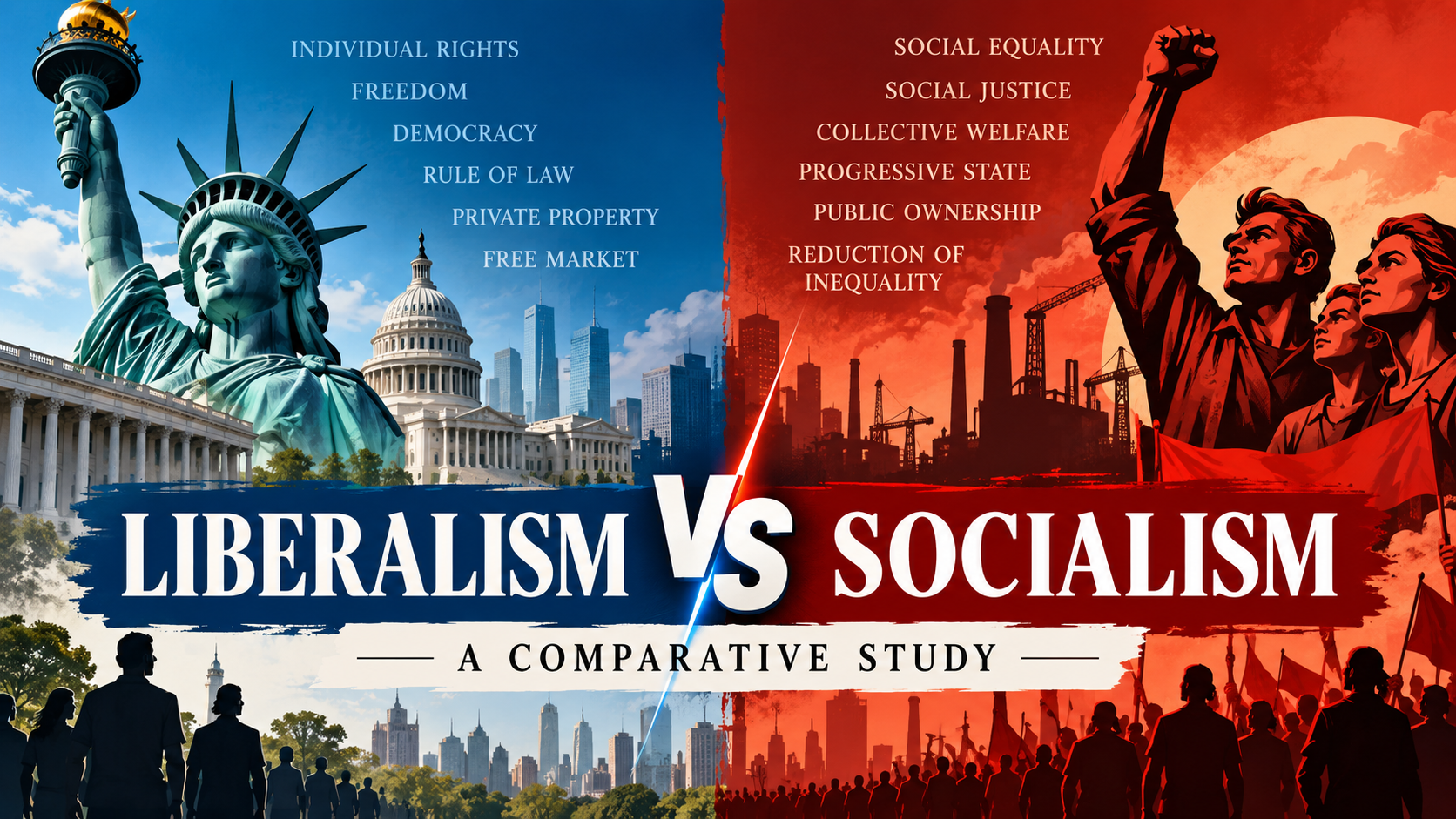
Liberalism and socialism are two of the most influential political ideologies in modern political thought. Both emerged as responses to major social, economic, and political transformations, particularly those associated with the rise of modern Europe, industrialisation, capitalism, and the struggle for political rights. Yet they developed different understandings of freedom, equality, property, the state, and the organisation of the economy.
At the centre of liberalism is the individual. Liberal thinkers generally argue that individuals possess rights and freedoms that political institutions must respect. Liberty, constitutional government, rule of law, private property, individual choice, and political participation therefore occupy an important place in liberal thought. Classical liberalism traditionally favoured a limited state and a relatively free market, although modern liberalism has accepted a more active role for government in promoting social welfare and equal opportunity.
Socialism, by contrast, places greater emphasis on social equality, collective interests, economic justice, and the social ownership or regulation of productive resources. Socialist thinkers developed their arguments partly as a response to the inequalities produced by industrial capitalism. They questioned whether political freedom could be meaningful when economic power was concentrated in the hands of a small section of society. For socialists, therefore, freedom is often connected with material conditions, social security, and equality.
The relationship between liberalism and socialism is not simply one of absolute opposition. Historically, the two traditions have influenced one another. Liberal democracies have adopted several policies associated with socialism, such as public education, social security, labour protection, and universal healthcare. At the same time, many contemporary socialist and social-democratic movements accept constitutional democracy, civil liberties, political pluralism, and electoral competition—ideas strongly associated with liberalism.
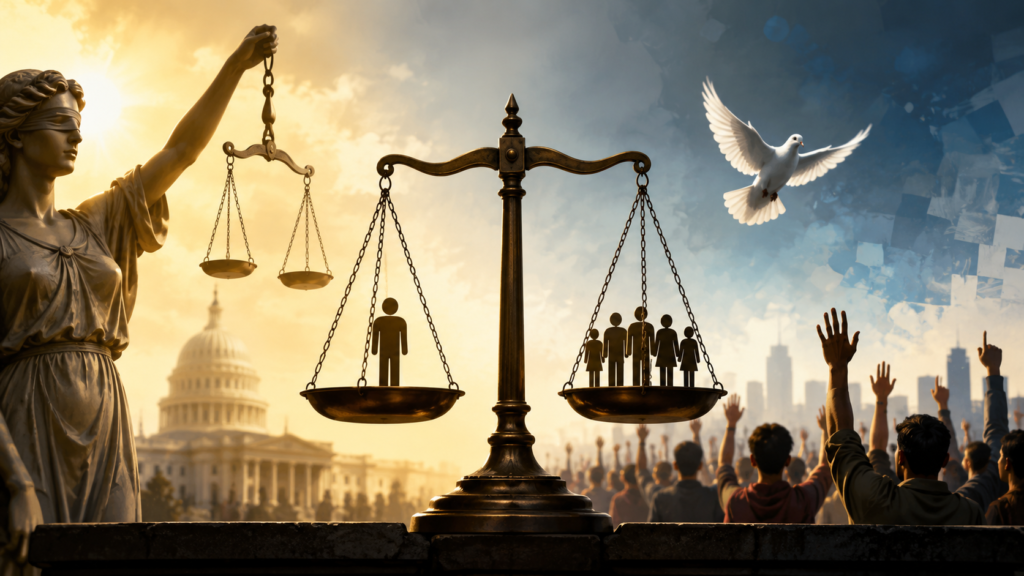
A comparative study of liberalism and socialism is therefore important because it helps students understand some of the fundamental debates in political science: How much freedom should individuals have? How much equality should society seek? What should be the role of the state? Who should control economic resources? And can political liberty exist without economic justice?
Table of Contents
Historical Origins of Liberalism
The roots of liberalism can be traced to the intellectual transformations of the seventeenth and eighteenth centuries. The Renaissance, Reformation, Scientific Revolution, and Enlightenment challenged traditional forms of authority and encouraged greater emphasis on reason, individual autonomy, and human rights.
Thinkers such as John Locke played a foundational role in liberal political thought. Locke argued that individuals possess natural rights, particularly rights to life, liberty, and property. Government, according to Locke, exists primarily to protect these rights and derives its legitimacy from the consent of the governed.
The development of liberalism was also connected with opposition to absolute monarchy and arbitrary government. Liberal thinkers demanded constitutional limitations on political power, equality before the law, religious toleration, and representative government. The American and French Revolutions helped spread liberal ideas about citizenship, rights, constitutionalism, and popular sovereignty.
During the nineteenth century, classical liberalism became closely associated with free-market capitalism. Thinkers such as Adam Smith emphasised economic freedom and argued that individuals pursuing their interests within competitive markets could contribute to wider economic prosperity. John Stuart Mill later expanded liberal thought by defending individual liberty, freedom of expression, and individuality.
However, industrial capitalism also exposed serious limitations in classical liberalism. Economic inequality, poor working conditions, child labour, and urban poverty created pressure for a new form of liberalism. By the twentieth century, social or modern liberals increasingly accepted government intervention to create conditions in which individuals could exercise their freedoms more effectively.
Historical Origins of Socialism
Socialism emerged primarily in response to the social and economic consequences of industrial capitalism. The Industrial Revolution transformed production and created enormous economic growth, but it also produced severe inequalities between industrial owners and workers.
Early socialist thinkers such as Robert Owen, Charles Fourier, and Henri de Saint-Simon criticised the competitive and unequal nature of emerging capitalism. They proposed cooperative forms of economic organisation in which production would serve social needs rather than private profit alone. These thinkers are often described as “utopian socialists” because their proposals were based more on ideal social arrangements than on a systematic theory of historical development.
Karl Marx and Friedrich Engels later developed a more systematic critique of capitalism. Marx argued that capitalist society was fundamentally divided between classes. The bourgeoisie controlled the means of production, while the proletariat depended on selling its labour for wages. According to Marx, this economic relationship generated exploitation and class conflict.
Marxist socialism therefore sought a fundamental transformation of the economic structure of society. Marx envisioned the eventual abolition of class divisions and private ownership of the means of production. In his historical theory, capitalism would ultimately give way to socialism and, in the longer term, communism.
Socialism subsequently developed into several different traditions. Revolutionary Marxism, democratic socialism, social democracy, and various forms of state socialism have all interpreted socialist principles differently. Consequently, socialism cannot be understood as a single, uniform ideology.
Different Conceptions of Freedom
Freedom is central to both liberalism and socialism, but they interpret it differently.
Classical liberalism primarily emphasises negative liberty—freedom from external interference. An individual should be free from unnecessary restrictions imposed by the state or other authorities. Freedom of speech, religion, association, movement, and private economic activity are therefore important liberal values.
John Stuart Mill’s defence of individual liberty illustrates this approach. He argued that individuals should generally be free to pursue their own choices as long as they do not harm others.
Socialist thinkers have often criticised this understanding of freedom as incomplete. They argue that formal freedom does not automatically create meaningful freedom. A worker may legally be free to choose employment, for example, but if poverty leaves that person with no realistic alternative, the freedom may be largely theoretical.
Socialism therefore tends to emphasise positive liberty or the capacity to actually exercise freedom. Education, healthcare, employment, housing, and social security can be viewed as necessary conditions for meaningful freedom.
The difference can be expressed simply: liberalism asks, “What should the state not prevent me from doing?” Socialism asks, “What social and economic conditions must exist so that I can genuinely exercise my freedom?”
Modern political systems increasingly recognise that both dimensions of freedom matter.
Liberalism and Socialism on Equality
Equality is another major point of disagreement.
Liberalism generally supports legal and political equality. All citizens should be equal before the law and should have equal political rights. Classical liberals, however, did not necessarily demand equality of economic outcomes. They generally accepted differences in wealth as a possible consequence of individual choices, talents, effort, and market competition.
Modern liberalism has moved further toward equality of opportunity. It argues that individuals should have access to education, employment, political participation, and other opportunities regardless of social background.
Socialism places much greater emphasis on economic and social equality. Socialist thinkers argue that extreme inequalities in wealth and property can create unequal political power. If a small group controls most economic resources, that group may also acquire disproportionate influence over politics and society.
However, socialism does not necessarily mean that every individual must possess exactly the same amount of wealth. Different socialist traditions disagree over the degree of equality that should be achieved. The central concern is generally the reduction of structural inequality and the creation of a more equitable distribution of resources and opportunities.
Property and Ownership
The question of private property represents one of the clearest differences between the two ideologies.
Classical liberalism considers private property an important individual right. Locke regarded property as closely connected to individual labour and liberty. Private ownership provides individuals with economic independence and can encourage investment, innovation, and entrepreneurship.
Socialism questions whether private ownership of major productive resources should be treated as an unrestricted right. Marx, in particular, distinguished between personal possessions and private ownership of the means of production. Socialist criticism is primarily directed at the private control of productive resources—such as factories, large-scale industries, and capital—when such ownership allows one class to exercise economic power over another.
Different forms of socialism propose different alternatives. Some advocate public ownership, others cooperative ownership, and democratic socialists may support a mixed economy in which strategically important sectors are publicly controlled while private enterprise continues in other areas.
Thus, the real debate is not simply “property versus no property.” It is about who should control economically significant resources and for whose benefit those resources should be used.
The Role of the State

Liberal and socialist approaches to the state have also evolved considerably.
Classical liberalism generally prefers a limited government. The state should maintain law and order, protect rights, enforce contracts, provide national defence, and perform other essential functions while leaving individuals substantial economic and social freedom.
Modern liberalism accepts a broader role for government. The state may regulate markets, provide welfare programmes, protect workers, fund education, and intervene when market outcomes threaten social stability or individual opportunity.
Socialism generally assigns the state a more significant role in organising economic and social life, although socialist traditions differ sharply over how much state power is desirable. Democratic socialism may favour extensive public services and regulation within a constitutional democracy, while revolutionary Marxism historically envisioned a transition involving significant political transformation.
An important paradox emerges here. Socialism seeks to reduce economic domination, but excessive concentration of political power in the state can itself threaten liberty. The historical experience of authoritarian regimes claiming to represent socialism demonstrates the danger of allowing political power to become unchecked.
Consequently, contemporary democratic socialism generally emphasises constitutional rights, democratic institutions, elections, and political accountability.
Liberalism and Socialism on Capitalism
Liberalism historically played an important role in the development of capitalism. Classical liberals generally viewed voluntary exchange, competition, private enterprise, and market mechanisms as essential components of economic freedom.
Markets allow individuals to decide what to produce, purchase, sell, and invest in. Supporters argue that competition can promote efficiency and innovation. However, unregulated markets can also produce monopolies, exploitation, environmental damage, and severe inequality.
Socialism developed partly as a critique of these problems. Marx argued that capitalism systematically creates class divisions because owners of capital seek profit while workers depend on wages. Socialists therefore seek greater social control over economic production.
Nevertheless, contemporary socialist thought does not necessarily reject markets entirely. Many social-democratic systems combine private enterprise with progressive taxation, labour rights, public services, and welfare programmes. This mixed approach demonstrates that the actual relationship between capitalism and socialism can be more complicated than ideological definitions suggest.
Democracy and Political Institutions
Liberalism has a strong historical connection with constitutional democracy. Liberal democracy protects individual rights while allowing citizens to participate in government through elections, political parties, representative institutions, and an independent judiciary.
Socialism also has a long democratic tradition. Democratic socialists argue that economic democracy is necessary to complement political democracy. A society may give citizens equal voting rights while allowing enormous concentrations of economic power to remain outside democratic control.
This leads to an important socialist question: Can democracy remain fully democratic when wealth is extremely concentrated?
Liberal theorists may respond that constitutional rights, competition, and the rule of law can limit abuses of economic power. Socialists, meanwhile, argue that economic inequalities can influence political institutions through lobbying, campaign financing, media ownership, and unequal access to political resources.
The strongest democratic systems therefore attempt to protect both political liberty and social inclusion.
Individualism versus Collectivism
Liberalism is traditionally associated with individualism. Society is viewed as consisting of individuals who possess rights and interests that cannot simply be sacrificed for collective purposes. Individual autonomy is therefore a fundamental value.
Socialism gives greater importance to collective interests. Human beings are understood as social beings whose opportunities are strongly influenced by economic institutions and social relationships. Cooperation, solidarity, and collective responsibility therefore become important values.
However, the distinction should not be exaggerated. Liberalism does not necessarily reject community, and socialism does not necessarily reject individuality. Modern liberal societies recognise social responsibilities, while democratic socialist traditions generally recognise individual rights.
The deeper difference concerns which should receive priority when individual and collective interests conflict.
Welfare and Social Justice
One of the most significant areas of convergence between modern liberalism and socialism is the idea of social welfare.
Classical liberals were cautious about government welfare because they feared dependence on the state and excessive taxation. Modern liberals, however, generally recognise that poverty and structural disadvantage can prevent individuals from exercising their rights effectively.
Socialism places welfare much closer to the centre of political philosophy. Education, healthcare, housing, social security, employment protection, and other public services are viewed as mechanisms for reducing inequality and ensuring social justice.
The welfare state in many contemporary democracies represents a compromise between these traditions. Private markets continue to operate, but governments provide public services and regulate economic activity.
This development demonstrates that political ideologies often change through interaction rather than remaining completely separate.
Major Criticisms of Liberalism
Liberalism has made important contributions to modern political life, especially through its defence of individual rights, constitutionalism, freedom of expression, religious liberty, and democratic government. Nevertheless, it has faced several criticisms.
One major criticism is that excessive emphasis on individualism can weaken social solidarity. If every problem is interpreted primarily as an individual’s responsibility, structural causes of poverty and inequality may be ignored.
Another criticism concerns economic inequality. A formally free market may generate enormous differences in wealth and power. Wealthier individuals and corporations may possess greater opportunities to influence political institutions than poorer citizens.
Classical liberalism has also been criticised for assuming that individuals participate in markets from relatively equal positions. In reality, inherited wealth, education, social class, gender, geography, and historical inequalities can significantly influence economic opportunities.
Modern liberalism attempts to address some of these problems through regulation and welfare policies, but the tension between market freedom and social equality remains.
Major Criticisms of Socialism
Socialism has also faced significant criticism.
Critics argue that extensive state control of economic activity can reduce incentives for innovation and entrepreneurship. If rewards are disconnected from performance or risk-taking, economic productivity may decline.
Another criticism concerns bureaucracy. Large state-controlled economic systems may become inefficient because decisions are made by administrative institutions rather than competitive markets. Historical experiences of centrally planned economies have strengthened this criticism.
A more serious political criticism concerns the concentration of state power. Attempts to establish socialism through authoritarian political structures have, in some historical cases, resulted in restrictions on political opposition, freedom of expression, and civil liberties.
However, these criticisms should not be applied equally to all forms of socialism. Democratic socialism and social democracy operate within pluralist political systems and retain many liberal democratic institutions.
Liberalism vs Socialism: A Comparative Perspective
| Dimension | Liberalism | Socialism |
|---|---|---|
| Central value | Individual liberty | Social and economic equality |
| View of society | Individual-centred | Community and class-conscious |
| Freedom | Emphasis on freedom from interference | Emphasis on meaningful/positive freedom |
| Property | Strong protection of private property | Greater social/public/cooperative ownership |
| Economy | Traditionally market-oriented | Greater regulation or social ownership |
| State | Limited in classical liberalism; active in modern liberalism | Generally more active in economic and social affairs |
| Equality | Equality before law and equality of opportunity | Greater emphasis on social and economic equality |
| Capitalism | Generally accepts it, with variations | Traditionally critical of capitalism |
| Welfare | More accepted under modern liberalism | Central to socialist political thought |
| Democracy | Constitutional and representative democracy | Political democracy plus, in many versions, economic democracy |
| Individual | Primary political unit | Individual understood within social relationships |
| Collective responsibility | Important but secondary to individual autonomy | Strong emphasis on solidarity and collective welfare |
This comparison reveals that liberalism and socialism should not be treated as completely rigid categories. Both contain multiple schools of thought, and contemporary political systems frequently combine elements of each.
Contemporary Relevance
The debate between liberalism and socialism remains highly relevant in the twenty-first century. Globalisation, automation, artificial intelligence, rising inequality, climate change, privatisation, unemployment, and the changing nature of work have created new questions about the relationship between markets, governments, and citizens.
The digital economy provides an interesting example. Liberal principles support innovation, entrepreneurship, freedom of expression, and private technological development. At the same time, socialist concerns emerge around the concentration of wealth, corporate power, data ownership, algorithmic control, and unequal access to technology.
Similarly, the COVID-19 pandemic demonstrated the importance of both markets and public institutions. Private businesses played a crucial role in producing goods and services, while governments became essential for healthcare, economic support, vaccination programmes, and social protection.
In countries such as India, the political system incorporates elements associated with both traditions. Constitutional rights and individual freedoms reflect liberal principles, while welfare programmes, public education, reservations, labour protections, food security measures, and social assistance reflect concerns about social justice and equality.
The contemporary debate is therefore less about choosing between pure liberalism and pure socialism and more about determining the appropriate balance between individual freedom, economic efficiency, social justice, and democratic accountability.
Is a Synthesis Possible?
The historical development of modern political systems suggests that some synthesis between liberalism and socialism is possible.
Social democracy represents one important example. It accepts democratic institutions, private enterprise, and market mechanisms while supporting strong welfare systems, labour protections, progressive taxation, and public services.
Similarly, modern liberalism has moved away from the idea of a completely passive state. It recognises that government intervention may be necessary to correct market failures and create genuine equality of opportunity.
At the same time, democratic socialist movements have increasingly recognised the importance of individual rights, political pluralism, elections, constitutional government, and freedom of expression.
This convergence suggests that the most sustainable political systems may not fit neatly into one ideological category. Instead, they attempt to combine the strengths of different traditions while limiting their weaknesses.
Conclusion
Liberalism and socialism represent two major approaches to the organisation of political, economic, and social life. Liberalism places individual liberty, rights, constitutionalism, and political freedom at the centre of its philosophy. Socialism places greater emphasis on equality, social justice, collective responsibility, and the democratic control of economic resources.
The fundamental disagreement between them concerns the relationship between freedom and equality. Liberalism traditionally warns that excessive state intervention can threaten individual liberty, while socialism warns that unrestricted economic inequality can make political liberty meaningless for large sections of society.
Neither ideology, however, can be understood through its most extreme historical forms alone. Liberalism has evolved from classical laissez-faire thinking toward modern welfare liberalism. Socialism has also developed from revolutionary and centrally planned models toward democratic socialism and social democracy.
The most important lesson for political science students is that freedom and equality should not necessarily be treated as mutually exclusive values. A society that protects individual liberty but ignores extreme inequality may produce formal freedom without genuine opportunity. Conversely, a society that pursues equality through excessive state control may undermine the very freedoms it seeks to protect.
The central challenge of modern democracy is therefore to find an appropriate balance. Political institutions must protect individual rights while also addressing poverty, discrimination, economic inequality, and unequal access to social opportunities. Markets can generate innovation and prosperity, but democratic governments may need to regulate them to prevent exploitation and excessive concentration of power.
Ultimately, the liberalism-versus-socialism debate is not simply an argument between two historical ideologies. It is an ongoing debate about the kind of society human beings wish to build. How much freedom should individuals possess? How much inequality can a democratic society tolerate? What responsibilities do citizens owe one another? And how should political power relate to economic power?
These questions remain central to contemporary political theory. Understanding the differences and intersections between liberalism and socialism therefore enables students to analyse not only the history of political thought but also the continuing debates surrounding democracy, capitalism, welfare, equality, and social justice.
In this sense, the study of liberalism and socialism is ultimately a study of one of the oldest problems in political philosophy: how to create a society in which individuals can be free while ensuring that freedom is meaningful for everyone.
FAQs
1. What is liberalism?
Liberalism is a political ideology that emphasises individual liberty, fundamental rights, constitutional government, rule of law, and political freedom.
2. What is socialism?
Socialism is a political and economic ideology that emphasises social and economic equality, collective welfare, social justice, and greater public or collective control over productive resources.
3. What is the main difference between liberalism and socialism?
The central difference is their emphasis: liberalism traditionally prioritises individual liberty and private rights, while socialism places greater emphasis on economic equality, collective welfare, and social justice.
4. Do liberalism and socialism support democracy?
Yes. Liberalism has a strong association with constitutional and representative democracy. Democratic socialism also supports democratic institutions, elections, political participation, and civil liberties.
5. How does liberalism view private property?
Classical liberalism considers private property an important individual right and generally supports private ownership and voluntary economic exchange.
6. How does socialism view private property?
Socialism is more critical of private ownership of major productive resources. Many socialist approaches favour public, collective, or cooperative ownership, although democratic socialist models may retain substantial private enterprise.
7. What is the liberal view of freedom?
Liberalism traditionally emphasises individual freedom from unnecessary interference by the state or other authorities. Freedom of speech, religion, association, and personal choice are important liberal values.
8. What is the socialist view of freedom?
Socialism generally argues that formal political freedom is insufficient without adequate economic and social conditions. Education, healthcare, employment, and social security can help make freedom meaningful.
9. Which ideology supports greater economic equality?
Socialism generally places greater emphasis on economic equality and reducing large differences in wealth and economic power.
10. Does liberalism support capitalism?
Classical liberalism is closely associated with free markets and capitalism. Modern liberalism, however, generally accepts government regulation and welfare policies to address market failures and inequality.
11. Why do socialists criticise capitalism?
Socialists argue that capitalism can generate class inequality, concentration of wealth, exploitation of labour, and unequal control over economic resources.
12. What is the role of the state in liberalism?
Classical liberalism prefers a limited state focused on protecting rights, maintaining law and order, and enforcing contracts. Modern liberalism accepts a more active state in areas such as welfare, education, and economic regulation.
13. What is the role of the state in socialism?
Socialism generally supports a stronger role for the state or other collective institutions in regulating or organising economic activity and providing social welfare, although different socialist traditions vary considerably.
14. Can liberalism and socialism coexist?
Yes. Modern political systems often combine liberal and socialist principles. Social-democratic systems, for example, combine private markets and individual rights with welfare programmes, progressive taxation, labour protections, and public services.
15. Which is better: liberalism or socialism?
There is no universally accepted answer. Liberalism offers strong protections for individual liberty and political rights, while socialism provides a stronger framework for economic equality and social welfare. Contemporary democracies often combine elements of both.