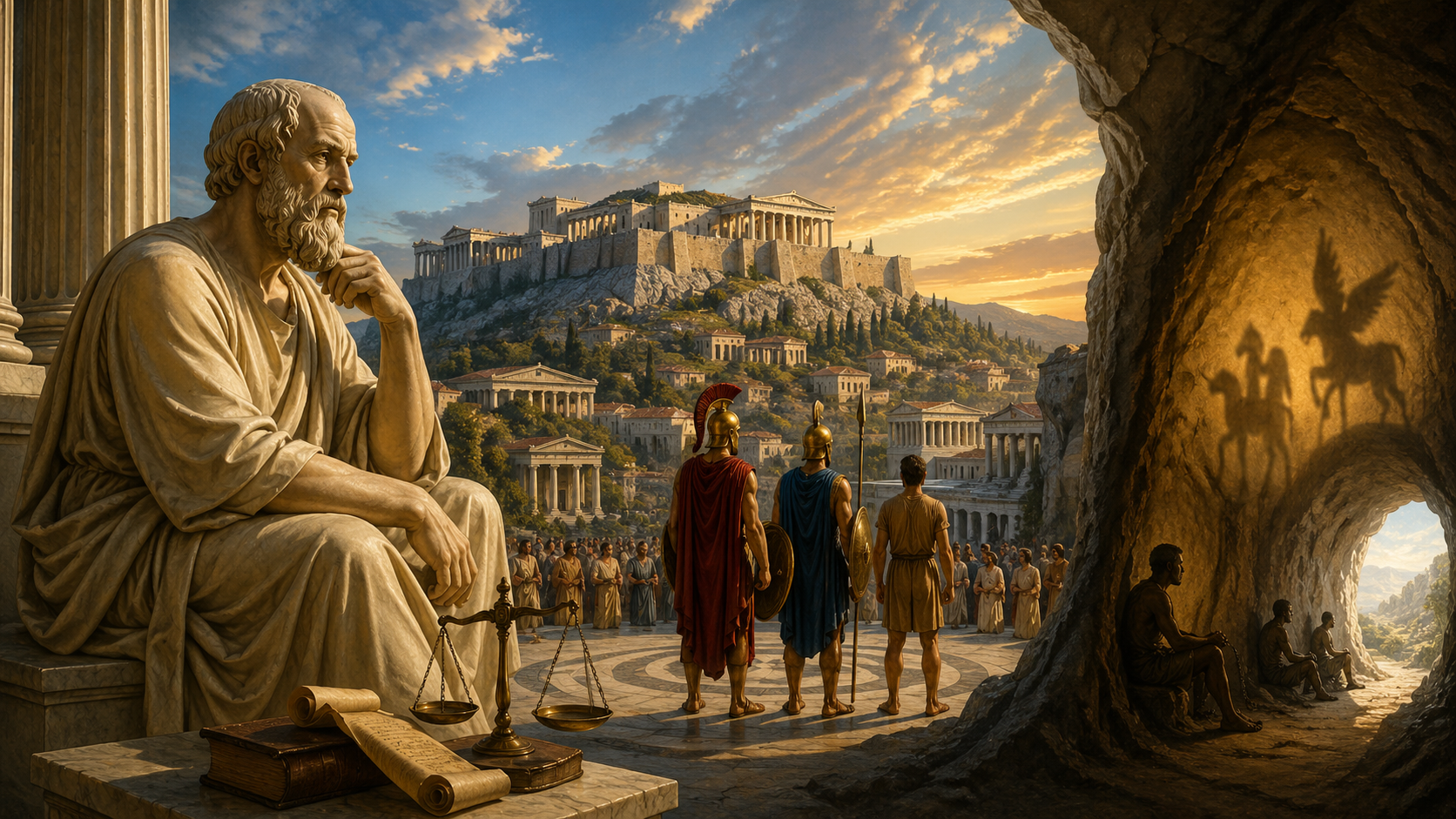
The political philosophy of Plato remains one of the most enduring intellectual legacies in the history of political thought. Among his many works, The Republic stands out as a foundational text that explores justice, the ideal state, education, ethics, and governance. Written in the form of a Socratic dialogue, the book presents a systematic vision of a just society governed by wisdom and reason rather than power or wealth. For students of political science, Plato’s Republic is not merely a philosophical treatise; it is an ambitious attempt to define justice at both individual and societal levels and to propose a radical model of governance led by the Philosopher King.
This article examines Plato’s concept of justice and his theory of the Philosopher King, highlighting their relevance, strengths, and criticisms.
Table of Contents
Historical and Philosophical Context
Plato lived during a period of political instability in Ancient Athens, marked by the decline of democracy and the aftermath of the Peloponnesian War. The execution of his teacher Socrates by the Athenian state deeply influenced Plato’s distrust of democracy and shaped his search for a more just and rational political order.
Plato believed that politics should not be driven by popular opinion or the desires of the majority but by knowledge and truth. His Republic is thus both a critique of existing political systems and a blueprint for an ideal state.
The Central Question: What is Justice?
The Republic begins with a fundamental question: What is justice? Plato approaches this question through a dialogue involving Socrates and several interlocutors, each offering different definitions of justice.

Early Definitions of Justice
- Justice as telling the truth and repaying debts (Cephalus)
- Justice as helping friends and harming enemies (Polemarchus)
- Justice as the advantage of the stronger (Thrasymachus)
Plato, through Socrates, systematically critiques these views. He rejects the idea that justice is merely a tool of the powerful or a matter of conventional morality. Instead, he seeks a deeper, universal definition.
Justice as Harmony
Plato ultimately defines justice as a form of harmony or balance, both within the individual and within the state.
Justice in the Individual
Plato divides the human soul into three parts:
- Rational (Reason) – seeks truth and knowledge
- Spirited (Will) – associated with courage and honor
- Appetitive (Desire) – concerned with physical needs and pleasures
Justice occurs when each part of the soul performs its proper function and reason governs the whole. Injustice arises when desires dominate or when internal imbalance disrupts harmony.
Justice in the State
Plato extends this psychological model to society. He divides the ideal state into three classes:
- Rulers (Philosophers) – guided by reason
- Auxiliaries (Warriors) – guided by spirit
- Producers (Farmers, artisans, traders) – driven by appetite
Justice in the state means that each class performs its appropriate role without interfering with others. This principle is often summarized as “doing one’s own work.”
Thus, justice is not about equality in the modern sense but about functional specialization and order.
The Ideal State
Plato’s ideal state is built on the principle of specialization and moral education. Each individual is assigned a role based on their natural abilities, ensuring efficiency and harmony.
Key Features of the Ideal State
- Division of labor based on aptitude
- Strict class structure
- Emphasis on education and moral development
- Collective living for the guardian class
- Subordination of individual interests to the common good
Plato believed that such a state would eliminate conflict, corruption, and injustice.
Education and Moral Development
Education plays a crucial role in Plato’s political philosophy. He argues that only through proper education can individuals develop the virtues necessary for justice.
Stages of Education
- Basic Education – music and gymnastics for character formation
- Advanced Education – mathematics and abstract thinking
- Philosophical Training – dialectics and pursuit of truth
Only those who successfully complete this rigorous process can become rulers. Education, therefore, acts as a filter to identify the most capable and virtuous individuals.
The Philosopher King
Perhaps the most famous and controversial idea in The Republic is Plato’s concept of the Philosopher King.
Who is the Philosopher King?
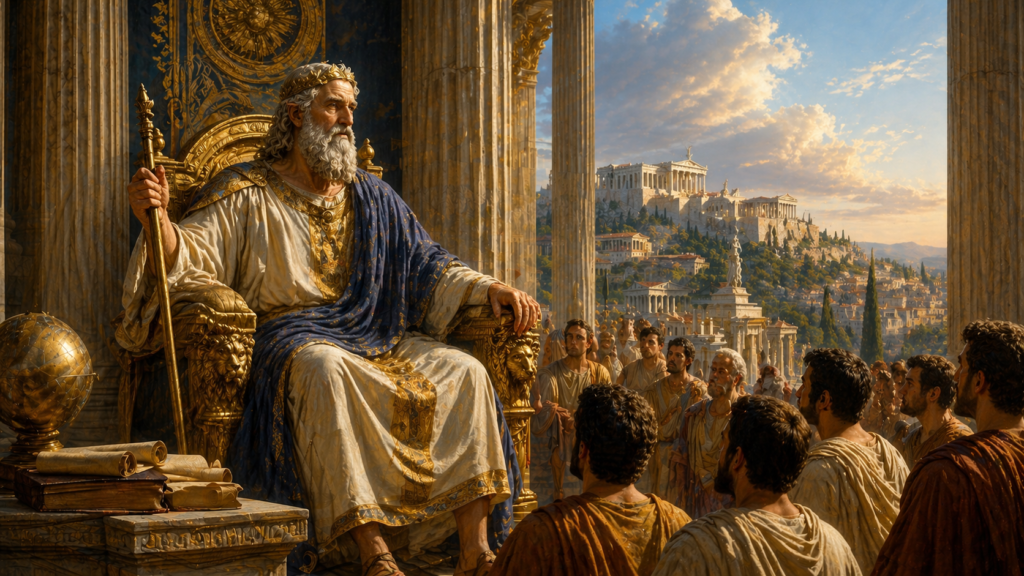
The Philosopher King is a ruler who possesses:
- Knowledge of the ultimate truth (the Form of the Good)
- Wisdom and rationality
- Moral integrity
- Lack of personal ambition for power
Plato famously states that “until philosophers rule as kings or those who are now called kings and leading men genuinely and adequately philosophize… there will be no end to troubles for states.”
The Theory of Forms
To understand the Philosopher King, one must grasp Plato’s Theory of Forms. Plato believed that the physical world is only a shadow of a higher reality composed of perfect, unchanging forms.
The Philosopher King, through education and reasoning, gains knowledge of these forms, especially the Form of the Good. This knowledge enables him to make just decisions for the benefit of the entire state.
The Allegory of the Cave
One of the most powerful illustrations in The Republic is the Allegory of the Cave. Plato describes prisoners chained inside a cave, mistaking shadows on the wall for reality. When one prisoner escapes and sees the outside world, he realizes the truth.
This allegory symbolizes:
- Ignorance vs. knowledge
- Illusion vs. reality
- The philosopher’s journey toward truth
The Philosopher King is like the freed prisoner who returns to the cave to guide others, even if they resist or misunderstand him.
Communism of the Guardians
Plato proposes a form of communism for the ruling and warrior classes:
- No private property
- No traditional family structure
- Shared responsibilities
The aim is to prevent corruption and ensure that rulers act in the public interest rather than pursuing personal wealth or power.
However, this idea applies only to the guardian class, not to the entire society.
Criticism of Plato’s Concept of Justice
While Plato’s theory is intellectually profound, it has faced significant criticism.
Lack of Individual Freedom
Plato’s rigid class structure limits personal choice and freedom. Individuals cannot choose their profession or social role, which conflicts with modern democratic values.
Elitism
The idea that only philosophers are fit to rule is seen as elitist. Critics argue that it undermines the principle of political equality.
Authoritarian Tendencies
Plato’s ideal state has been described as authoritarian because:
- It restricts freedom of expression
- It controls education and culture
- It prioritizes the state over the individual
Philosophers like Karl Popper have criticized Plato for laying the foundations of totalitarianism.
Unrealistic Ideal
Many scholars argue that Plato’s model is too idealistic and impractical. The assumption that rulers can be completely selfless and wise is difficult to sustain in real-world politics.
Relevance in Modern Political Thought
Despite criticisms, Plato’s ideas remain highly influential.
Influence on Political Theory
Plato’s emphasis on justice, moral leadership, and education continues to shape political philosophy. His work influenced thinkers like Aristotle, who developed his own theory of politics in response to Plato.
Meritocracy and Expertise
The idea that leaders should be knowledgeable and competent resonates with modern concepts of meritocracy and technocracy.
Ethics in Governance
Plato’s insistence that rulers must be morally upright highlights the importance of ethics in politics, a concern that remains relevant today.
Justice Revisited: Individual vs. Society
One of the enduring strengths of Plato’s theory is the connection between individual morality and social justice. He suggests that a just society cannot exist without just individuals.
This idea raises important questions:
- Can justice be imposed from above?
- Is harmony more important than freedom?
- Should leaders be experts rather than elected representatives?
These questions continue to be debated in contemporary political discourse.
Conclusion
Plato’s Republic offers a profound exploration of justice and governance. By defining justice as harmony and proposing a state ruled by Philosopher Kings, Plato presents a vision of politics grounded in reason, morality, and knowledge.
While his ideas may appear rigid and idealistic, they challenge us to think critically about the nature of justice, the role of leadership, and the relationship between individual and society. For political science students, Plato’s work is not just a historical text but a living dialogue that continues to inspire, provoke, and inform.
Ultimately, the strength of Plato’s philosophy lies not in its practical implementation but in its ability to push us toward higher standards of justice and ethical governance.
FAQs
- What is justice according to Plato in Republic?
Justice is harmony, where each part of the soul and each class in society performs its proper role without interference. - What are the three parts of the soul in Plato’s theory?
Rational (reason), spirited (courage), and appetitive (desire). - How does Plato define justice in the state?
Justice in the state is achieved when rulers, auxiliaries, and producers perform their respective functions efficiently. - Who is the Philosopher King?
A ruler who possesses wisdom, knowledge of truth, and moral integrity, making decisions for the common good. - Why does Plato prefer philosophers as rulers?
Because they understand the Theory of Forms, especially the Form of the Good, enabling just governance. - What is the role of education in Plato’s ideal state?
Education identifies and trains individuals to fulfill their appropriate roles, especially preparing future rulers. - What is the Allegory of the Cave?
A metaphor explaining ignorance and enlightenment, where philosophers seek truth beyond illusions. - What are the three classes in Plato’s ideal state?
Rulers (philosophers), auxiliaries (warriors), and producers (economic class). - What is meant by “doing one’s own work”?
It means each individual should perform the role suited to their abilities without interfering in others’ roles. - Why does Plato oppose democracy?
Plato believed democracy leads to disorder because it allows unqualified individuals to rule. - What is the communism of guardians?
A system where rulers and warriors share property and family life to avoid corruption. - How is justice connected to individual morality?
A just individual has a balanced soul; similarly, a just state has a balanced structure. - Who criticized Plato’s political ideas as authoritarian?
Karl Popper argued that Plato’s model promotes totalitarianism. - Is Plato’s ideal state practical today?
Many consider it unrealistic, but its philosophical insights remain valuable. - What is the main aim of Plato’s Republic?
To define justice and design an ideal political system based on reason and morality.