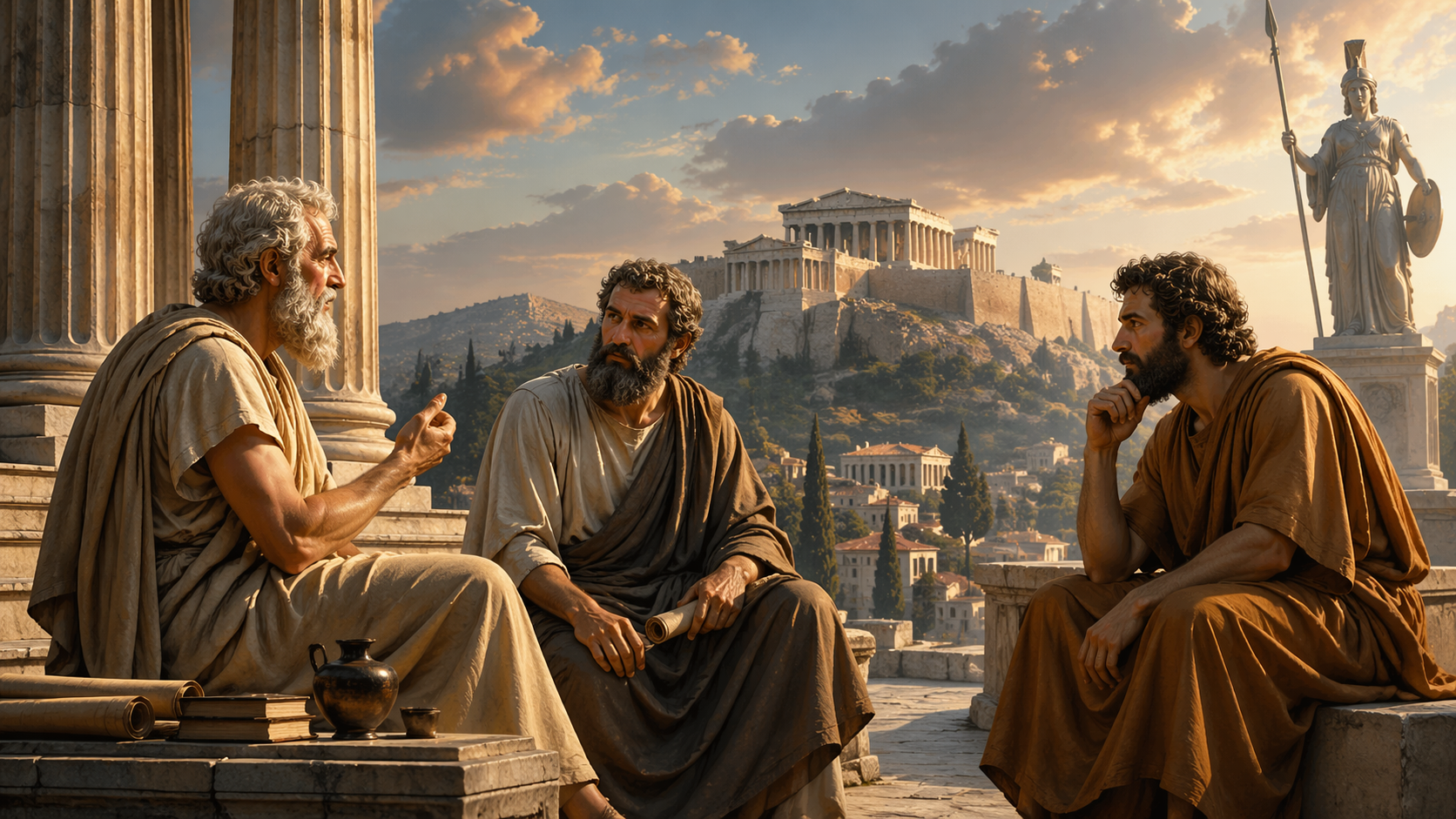
Greek political thought occupies a foundational place in the history of political theory. The ideas developed in ancient Greece—particularly in city-states like Athens—continue to shape contemporary political philosophy, democratic institutions, and ethical debates. For students of Political Science, understanding Greek political thought is not merely an exploration of antiquity but an entry point into enduring questions about justice, governance, citizenship, and the role of the state.
This article explores the origins, development, and core themes of Greek political thought, focusing on major thinkers such as Socrates, Plato, and Aristotle, whose works laid the intellectual groundwork for Western political philosophy.
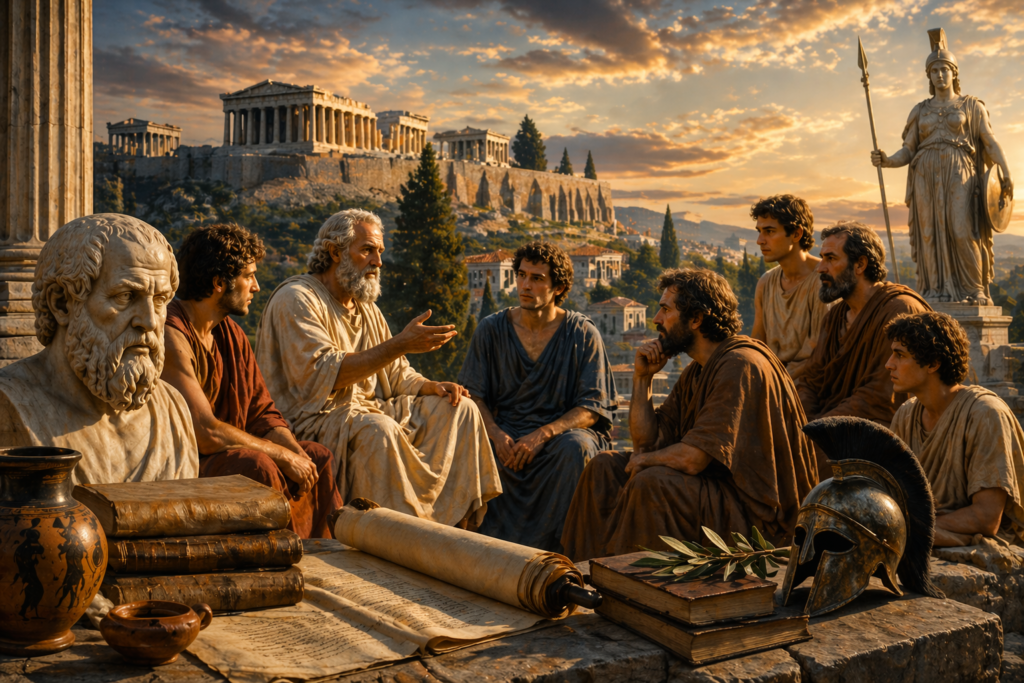
Table of Contents
Historical Context: The Greek Polis
Greek political thought emerged within the context of the polis, or city-state. Unlike modern nation-states, the Greek polis was a small, self-governing community where citizens actively participated in political life. Prominent examples include Athens, Sparta, and Corinth, each with its own political structure.
Athens, in particular, became the birthplace of democracy. The Athenian system allowed male citizens to participate directly in decision-making, debate laws, and hold public office. This political environment fostered philosophical inquiry into the nature of justice, citizenship, and governance.
Greek thinkers were not writing abstract theories detached from reality; rather, they were responding to concrete political experiences such as war, tyranny, oligarchy, and democracy. The Peloponnesian War, for instance, exposed the weaknesses of Athenian democracy and deeply influenced philosophical reflections on politics.
The Sophists: Early Political Thinkers
Before the emergence of the great philosophers, the Sophists played a significant role in shaping political thought. They were itinerant teachers who emphasized rhetoric, persuasion, and practical knowledge necessary for participation in public life.
Sophists like Protagoras argued that “man is the measure of all things,” suggesting a form of relativism in truth and morality. This idea challenged traditional beliefs about absolute justice and universal values. In politics, this meant that laws and norms were seen as human constructs rather than divine mandates.
Although often criticized for promoting skepticism and moral relativism, the Sophists contributed to the democratization of knowledge and encouraged critical thinking about political authority.
Socrates: Ethics and the Foundations of Political Thought
Socrates is often considered the moral conscience of Greek political thought. Unlike the Sophists, Socrates sought objective truths about justice, virtue, and the good life. He did not leave written works, but his ideas are preserved through the dialogues of Plato.
Socrates believed that knowledge and virtue were intimately connected. For him, a just society could only exist if individuals pursued moral truth and self-knowledge. His method of inquiry, known as the Socratic method, involved asking probing questions to expose contradictions and stimulate critical thinking.

Politically, Socrates was skeptical of democracy, particularly because it allowed individuals without knowledge or expertise to make important decisions. His trial and execution by the Athenian state highlighted the tension between individual conscience and political authority. Socrates’ death became a powerful symbol of the conflict between truth and power.
Plato: Idealism and the Just State
Plato, a student of Socrates, developed one of the most comprehensive systems of political thought in his work The Republic. Plato was deeply influenced by the execution of Socrates and sought to design a political system that would prevent such injustices.
At the heart of Plato’s philosophy is the concept of justice. He argued that justice exists when each part of society performs its appropriate function. In his ideal state, society is divided into three classes:
- Rulers (philosopher-kings)
- Guardians (soldiers)
- Producers (farmers, artisans, merchants)
Plato believed that philosopher-kings, who possess knowledge of the Forms (ultimate truths), are best suited to rule. His model emphasizes wisdom, rationality, and moral integrity as the basis of political authority.
Plato was critical of democracy, viewing it as a system prone to disorder and demagoguery. He argued that democracy could degenerate into tyranny if leaders manipulate public opinion.
Another key aspect of Plato’s thought is the communal life of the ruling class, including shared property and family arrangements, designed to eliminate corruption and promote unity.
Aristotle: Empiricism and Political Realism
Aristotle, a student of Plato, took a more empirical and practical approach to political thought. His work Politics is based on the study of various constitutions and political systems.
Aristotle defined humans as “political animals,” emphasizing that participation in political life is essential to human flourishing. Unlike Plato, Aristotle did not advocate for an ideal state detached from reality. Instead, he analyzed existing political systems to determine which forms of government were most effective.
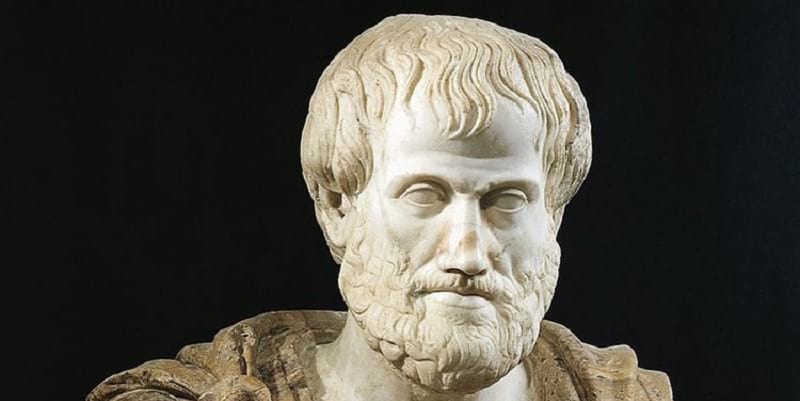
Aristotle classified governments into three good forms and their corrupt counterparts:
- Monarchy (good) → Tyranny (corrupt)
- Aristocracy (good) → Oligarchy (corrupt)
- Polity (good) → Democracy (corrupt, in his view when it serves only the poor)
However, Aristotle’s critique of democracy was more nuanced than Plato’s. He recognized the potential value of a mixed constitution, combining elements of democracy and oligarchy, to achieve stability and balance.
Aristotle also emphasized the importance of the middle class in maintaining political stability. He believed that a strong middle class could prevent the extremes of wealth and poverty that often lead to conflict.
Key Themes in Greek Political Thought
Justice
Justice is a central concern for Greek thinkers. For Plato, justice is harmony within the state and the individual soul. For Aristotle, justice involves fairness and the equitable distribution of goods and honors.
Citizenship
Greek political thought places great emphasis on active citizenship. Participation in public life was seen as both a duty and a privilege. Aristotle, in particular, argued that a citizen is someone who shares in the administration of justice and governance.
The Role of the State
Greek philosophers debated the purpose of the state. Plato viewed the state as a means to achieve moral and intellectual perfection, while Aristotle saw it as a natural institution aimed at promoting the good life.
Democracy and Its Critique
Although Athens is celebrated as the birthplace of democracy, Greek thinkers were often critical of it. They questioned whether the masses possessed the knowledge and virtue necessary for effective governance.
Ethics and Politics
Greek political thought does not separate ethics from politics. The moral character of individuals and rulers is seen as essential to the functioning of the state. This integration of ethics and politics remains a significant contribution to political philosophy.
Relevance of Greek Political Thought Today
Greek political thought continues to influence modern political systems and theories. Concepts such as democracy, citizenship, rule of law, and constitutionalism have their roots in ancient Greece.
Modern debates about governance, inequality, and justice often echo the concerns of Greek philosophers. For example, discussions about the role of expertise in politics reflect Plato’s idea of philosopher-kings, while debates about participatory democracy resonate with Athenian practices.
Aristotle’s emphasis on the middle class is particularly relevant in contemporary discussions about economic inequality and political stability. Similarly, the Socratic commitment to questioning authority remains vital in democratic societies.
Criticism and Limitations
While Greek political thought is foundational, it is not without limitations. Greek democracy excluded women, slaves, and foreigners from political participation. This raises important questions about the universality of their ideas.
Moreover, some of Plato’s proposals, such as the abolition of family among the ruling class, are considered impractical or authoritarian. Aristotle’s acceptance of slavery as a natural institution also reflects the historical limitations of his thought.
Despite these shortcomings, Greek political philosophy provides a critical framework for analyzing and improving political systems.
Conclusion
Greek political thought represents the beginning of systematic reflection on politics, ethics, and society. The contributions of Socrates, Plato, and Aristotle continue to shape the study of Political Science and inform contemporary debates.
By engaging with Greek political thought, students gain insight into fundamental questions about human nature, justice, and governance. These ideas remain relevant because they address enduring challenges that every society must confront.
Understanding Greek political thought is not just about studying the past; it is about developing the intellectual tools to critically analyze the present and envision a better political future.
FAQs on Greek Political Thought
1. What is Greek political thought?
Greek political thought refers to the early philosophical ideas about politics, governance, justice, and citizenship developed in ancient Greece, especially by thinkers like Socrates, Plato, and Aristotle.
2. Why is Greek political thought important in Political Science?
Greek political thought forms the foundation of Western political theory, influencing concepts such as democracy, justice, law, and the role of the state.
3. Who are the main philosophers of Greek political thought?
The central figures in Greek political thought are Socrates, Plato, and Aristotle.
4. What is the role of the polis in Greek political thought?
In Greek political thought, the polis (city-state) is the core unit of political life where citizens actively participate in governance and decision-making.
5. How did Greek political thought view democracy?
Greek political thought had a mixed view of democracy—while Athens practiced it, philosophers like Plato criticized it for potential instability and lack of expertise.
6. What is justice according to Greek political thought?
In Greek political thought, justice is seen as harmony and fairness—Plato viewed it as functional harmony, while Aristotle emphasized distributive justice.
7. What is Plato’s ideal state in Greek political thought?
In Greek political thought, Plato proposed an ideal state ruled by philosopher-kings who possess wisdom and moral virtue.
8. How does Aristotle contribute to Greek political thought?
Aristotle contributed to Greek political thought by analyzing real political systems and advocating a balanced constitution.
9. What is the concept of citizenship in Greek political thought?
Greek political thought emphasizes active citizenship, where individuals participate directly in political processes and public affairs.
10. What is the connection between ethics and politics in Greek political thought?
Greek political thought closely links ethics with politics, arguing that moral virtue is essential for good governance and a just society.
11. What were the Sophists’ role in Greek political thought?
The Sophists contributed to Greek political thought by promoting rhetoric, relativism, and critical thinking about laws and political authority.
12. What are the main forms of government in Greek political thought?
Greek political thought identifies monarchy, aristocracy, and polity as good forms, along with their corrupt forms—tyranny, oligarchy, and extreme democracy.
13. What are the limitations of Greek political thought?
Greek political thought excluded women, slaves, and foreigners from political participation, limiting its democratic scope.
14. How is Greek political-thought relevant today?
Greek political thought remains relevant in modern debates on democracy, justice, governance, and political ethics.
15. What is the central idea of Greek political-thought?
The central idea of Greek political-thought is the pursuit of a just, ethical, and well-ordered society through rational governance and active citizenship.
1 thought on “Introduction to Greek Political Thought”